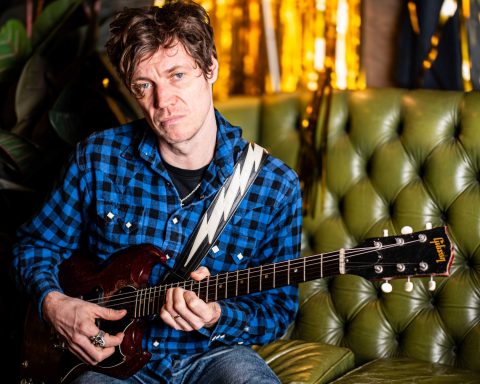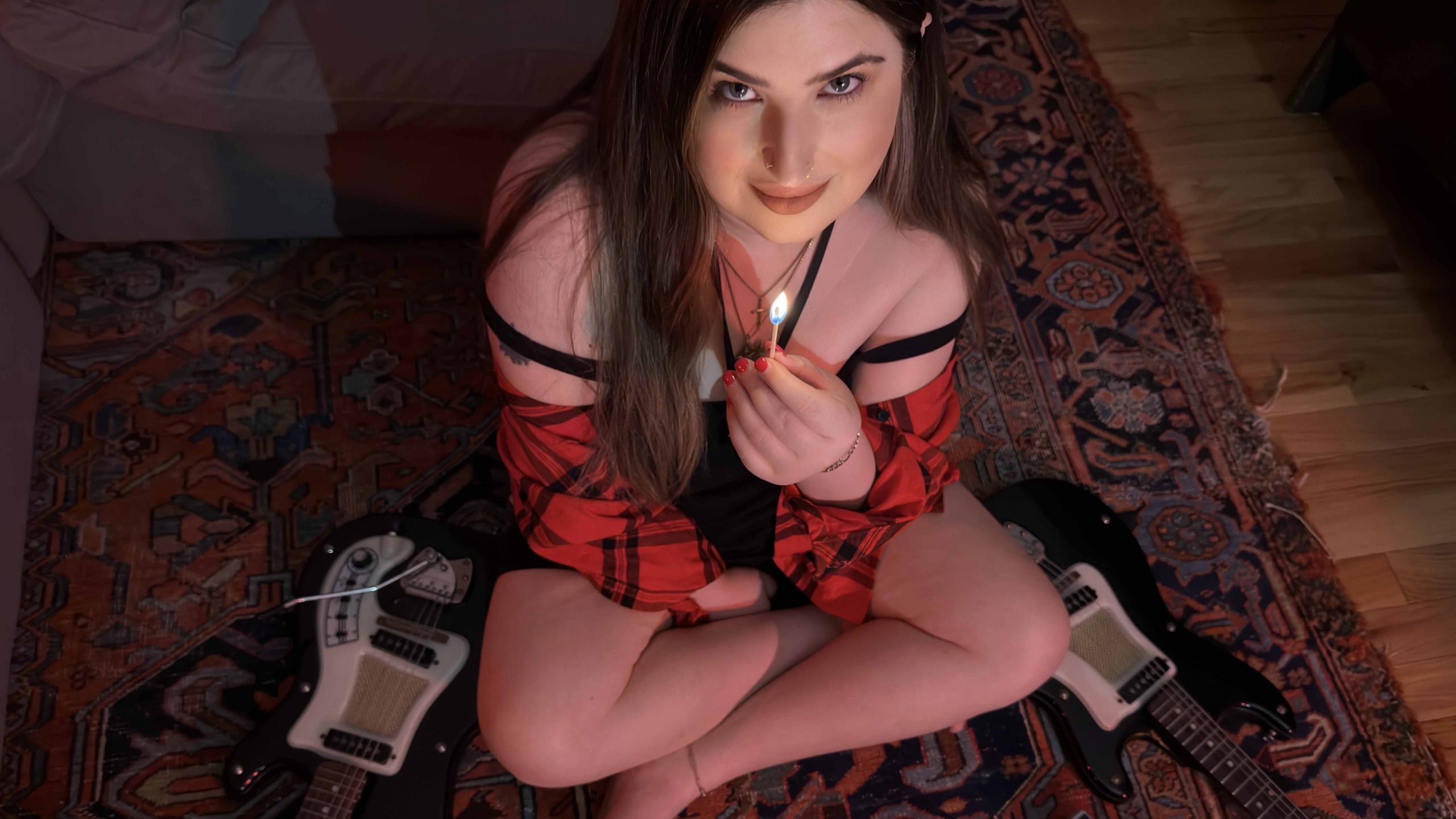


Ella Feingold’s storied list of session credits is immense. She has famously lent her world-renowned talents to multiple Grammy-winning artists like Silk Sonic (Bruno Mars and Anderson .Paak) and Erykah Badu. Yet the Massachusetts-based guitar phenom is a prolific creative force in her own right. From collaborations with household-name musicians to visionary solo work, Feingold continues to expand the scope of guitar playing with dexterity and imagination. In the wider online guitar community, she is recognized for her generous spirit while sharing insights on technique and tone. And in this revealing interview, Feingold delves into her inventive use of BOSS pedals on her solo album Tell a Beautiful Lie with Sound. It’s a testament to independent creativity—truly inspiring stuff for any guitarist looking to make music on their own terms.
Musical Exorcism
Last year saw the release of the Ella Feingold/Charlie Hunter collaboration Different Strokes for Different Folks, which Premier Guitar praised as “a masterwork of minimal funk.” Described by the artists as “a conversation between two friends spoken in the language of guitar,” the album is penned in Feingold’s familiar musical dialect of funk, jazz, and soul.
By contrast, her new solo offering, Tell a Beautiful Lie with Sound, was realized in solitude and articulates a six-string vocabulary all its own. Recorded in Jeff Buckley’s old bedroom on a Tascam Portastudio 424 four-track using BOSS pedals and released on Valentine’s Day 2026, it’s a fierce yet tender work that skilfully balances lo-fi directness and high-brow complexity.
Taking inspiration from the DIY albums of fellow Massachusettsan Lou Barlow (Dinosaur Jr., Sebadoh) and John Frusciante (notably Niandra LaDes and Usually Just a T-Shirt and To Record Only Water for Ten Days), Feingold calls this intrepid and highly original set of soundscapes “guitar exorcisms.”
For readers curious about the expressive power of guitar pedals, Tell a Beautiful Lie with Sound is essential listening. A masterclass in how to push the boundaries of effects, it reminds us of the vast range of possibilities that can be explored with even a modest set of BOSS stompboxes.
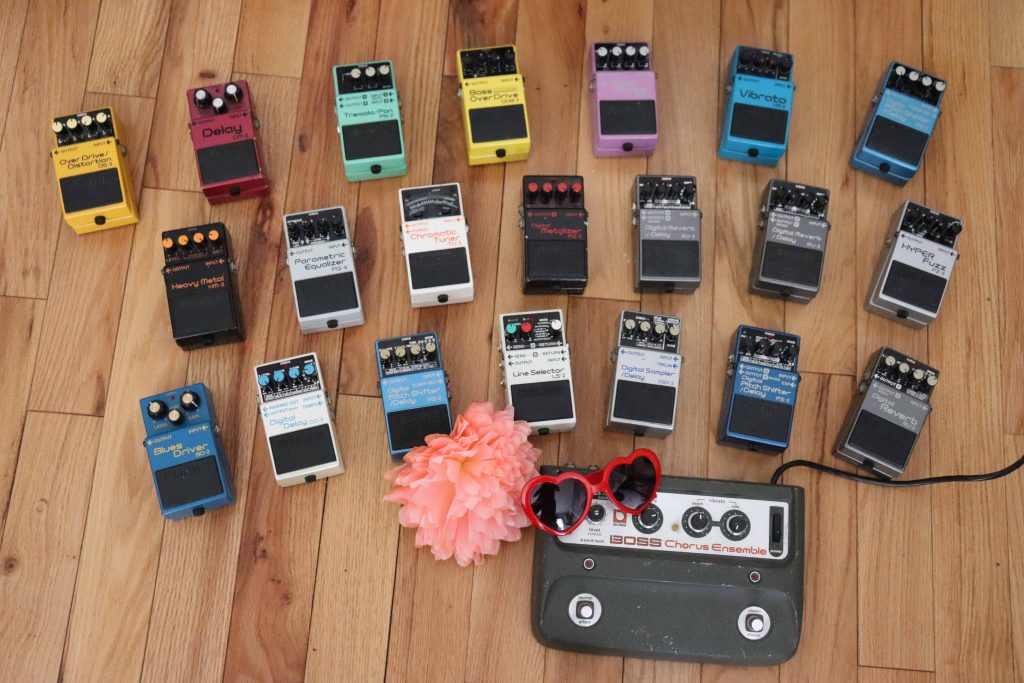
We caught up with Feingold to find out how she managed to conjure this magical album using a well-loved set of BOSS classics, including the FZ-2 Hyper Fuzz, PS-2 Digital Pitch Shifter/Delay, RV-2 Digital Reverb, RV-3 Digital Reverb/Delay, and DSD-2 Digital Sampler/Delay.
Tapping Into Creativity
How did you record Tell a Beautiful Lie with Sound?
I went to Memphis, and I did it in Jeff Buckley’s old house, in his bedroom. I just recorded it with a Tascam Portastudio 424, BOSS pedals, and an old Hagstrom guitar.
I took a stack of cassettes and stayed for a couple of weeks. I wrote and recorded everything in the house, then dumped the cassettes and did some additional overdubs—just things that I physically couldn’t bring on the plane.
What did it feel like recording in Jeff Buckley’s old bedroom?
It was heavy. I mean, during the day, it was beautiful because the sunlight that comes into the house just sort of holds you in a special way. It’s very warm and inviting. At night, it gets a little bit spooky.
"Jeff Buckley tapped into something in that house... I definitely tapped into something. Or something tapped into me."
How did being in Jeff Buckley’s old house affect the outcome of your recordings?
I could definitely feel something in the house. If not Jeff, just the energy of the place. It’s like he went there and was searching for something, you know. He left New York for Memphis [in 1997] to finish writing his album [working title: My Sweetheart the Drunk]. He tapped into something in that house. I’m not saying the house did it, but that’s where it happened.
In Jeff’s stuff, there was definitely a kind of guttural, punk/post-punk aesthetic that came out in songs like “Gunshot Glitter” and “Murder Suicide Meteor Slave.” And there are songs that never made the album [Sketches for My Sweetheart the Drunk, released in 1998] that are really just kind of jarring and spooky.

"I wasn't going there to make a Jeff Buckley record. I was going to make an Ella record. But I wondered what kind of energy I would feel."
When I went to the house, I wasn’t going there to make a Jeff Buckley record. I was going to make an Ella record. But I wondered what kind of energy I would feel. There were things that came out in my own music that surprised me—these violent guitar soundscape-y things that I’ve never done before.
Like the tone on “Your Life is Waiting for You”—I mean, I just instinctively moved some knobs and turned on some pedals and found that sound I’d never used before. There was definitely a kind of vulgar punk thing that came out in my music that’s never been there before. So I definitely tapped into something. Or something tapped into me.
Where is the house exactly?
It’s in Memphis, Tennessee, on North Rembert Street. You can rent it now on Airbnb. You’d never know that Jeff Buckley lived in the house. They don’t advertise any affiliation with him at all. But you can tell why he loved it.
He used to sit on the front lawn and lie on his back. I did that when I was there, with the trees just swaying, and the birds chirping. It’s so beautiful.
What are the acoustics like in the house?
One of the most important things about the house is its incredible acoustics. It’s all wood floors and high ceilings. It’s like a little shotgun shack from the 1920s. It’s a tiny, tiny house, but the hand claps in there are unbelievable. And so, you know, I tried to utilize the house as an instrument, too.
"BOSS is, without a doubt, my favorite pedal brand. It just connects with me on a spiritual level."
BOSS Family
You have a great collection of BOSS pedals.
BOSS is, without a doubt, my favorite pedal brand. It just connects with me on a spiritual level. It feels like home more than anything. I mean, I grew up with all of these pedals, and there are so many of them. It’s fun.
I’m still discovering BOSS pedals. I love the discontinued ones. It’s like a family. And every now and then, you suddenly realize you have a distant cousin you didn’t know about.
What was the last BOSS pedal you bought?
The last one I got was the PQ-4 Parametric Equalizer, which most people don’t even know about; they often only know the GE-7 Equalizer. The PQ-4 has a similar color scheme to my [FZ-2] Hyper Fuzz, and they’re right next to each other.
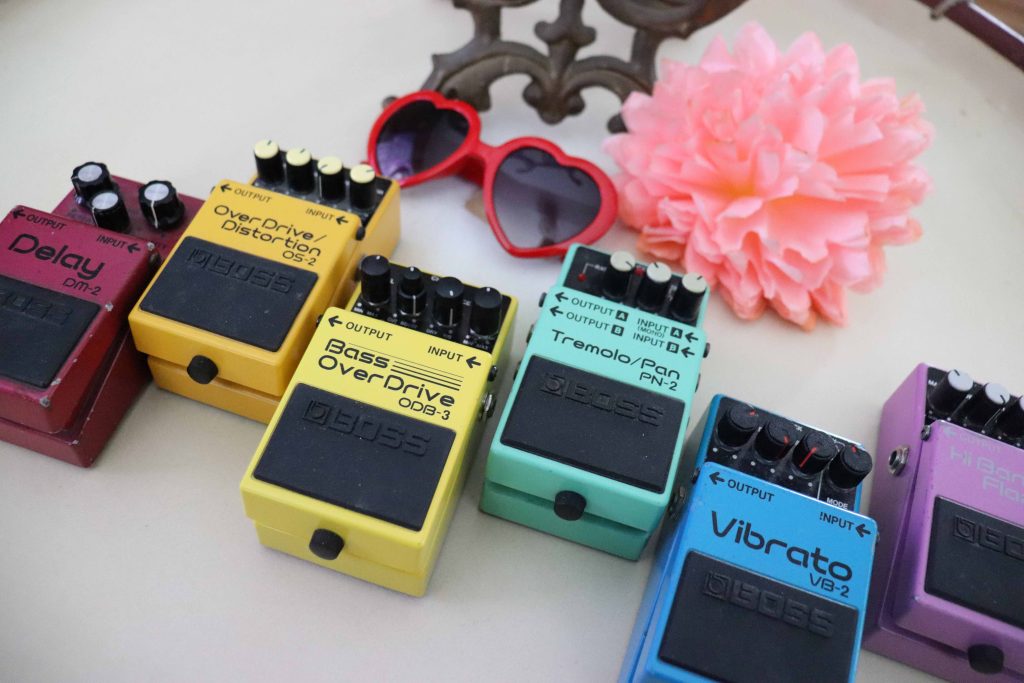
"I'm still discovering BOSS pedals. I love the discontinued ones. It's like a family."
I love the FZ-2 so much. If BOSS ever did a Waza Craft version, it would be amazing if it had dual outputs and you could run the Fuzz I and Fuzz II modes simultaneously. That would be crazy. Also, it would be cool if there were a way to turn off the octave sound so that you could play chords.
The FZ-2 Gain Boost mode is a sleeper, too. I can get some great James Brown/Jimmy Nolen-style strident tones just using that boost. You can overdrive your preamp into distortion using it, like I do on a four-track, just with that clean boost.
I probably use the more midrange-focused sound [Fuzz I] more, but I definitely like the scooped sound [Fuzz II].
"My top-three favorite BOSS pedals are the RV-3, the RV-2, and the PS-2."
BOSS Favorites
What’s your all-time favorite BOSS pedal?
My all-time favorite pedal is the RV-3 Digital Reverb/Delay. I love this one. I like pairing it with the scooped FZ-2 fuzz tone and dialing in a room sound, like an early reflection kind of thing. Those two—the FZ-2 and RV-3—just bloom in a really cool way together.
My top-three favorites are the RV-3, the RV-2, and the PS-2—as opposed to the PS-3 [Digital Pitch Shifter/Delay] or the PS-5 [SUPER Shifter]. I also love the DSD-2.
I don’t want to put those pedals down, but back then, it was like BOSS hadn’t yet perfected the chip or algorithm or something, you know. Like on the PS-2, the repeats can get really strident, and it has a distinct color.
"I probably use 20 different sounds from the RV-3."
Like when you’re trying to get an octave down or octave above, it’s not a perfect, super-clean octave; it sounds like it’s trying to do some math, but it’s freaking out and warbling. To me, that’s what makes it sound cool. When it gets to the PS-3 or the PS-5, it’s like, “Okay, we fixed it.” But it lost some of that nice instability.
How else do you like to use the BOSS RV-3 Digital Reverb/Delay?
I probably use 20 different sounds from the RV-3. The space it puts you in is neither lo-fi nor this high-fidelity, expensive sound. It sort of sits in between. I mean, it’s not lo-fi on purpose, but it’s kind of what I like about a lot of older BOSS pedals. It just sits in the middle, where it’s comfortably blue collar. It’s just your everyday working person’s kind of thing.
I record so much on my four-track, and I go direct a lot. The RV-3 sounds great going direct. I used two RV-3s—one for early reflections and slapback, and one for longer delay times with the feedback all the way up. I think I might have also used my DM-2 Delay on a song on Tell a Beautiful Lie with Sound.
"One of the things I love most is that I find everything—every sound—in BOSS pedals. I just eat up every nuance of it."
Heavy Duty
What else do you like about BOSS pedals?
Well, it’s great if you’re ever on the road. I mean, they’re just everywhere. And they’re still reasonably priced. You can still get PS-2s and DSD-2s for 150 to 200 bucks.
And with BOSS, the quality control is there—they’re tried and tested. BOSS are heavy-duty, rugged pedals, whereas a lot of these other smaller companies’ pedals are not always built well.
As I said, I just have such a connection to BOSS pedals because it feels like childhood. All we had back then were mostly BOSS, DOD, and DigiTech. We didn’t have all these boutique companies and everyone remaking remakes.
One of the things I love most is that I find everything—every sound—in BOSS pedals. I just eat up every nuance of it. Like I’m using all of the pedal, as opposed to say having an RV-3 and just using one setting.
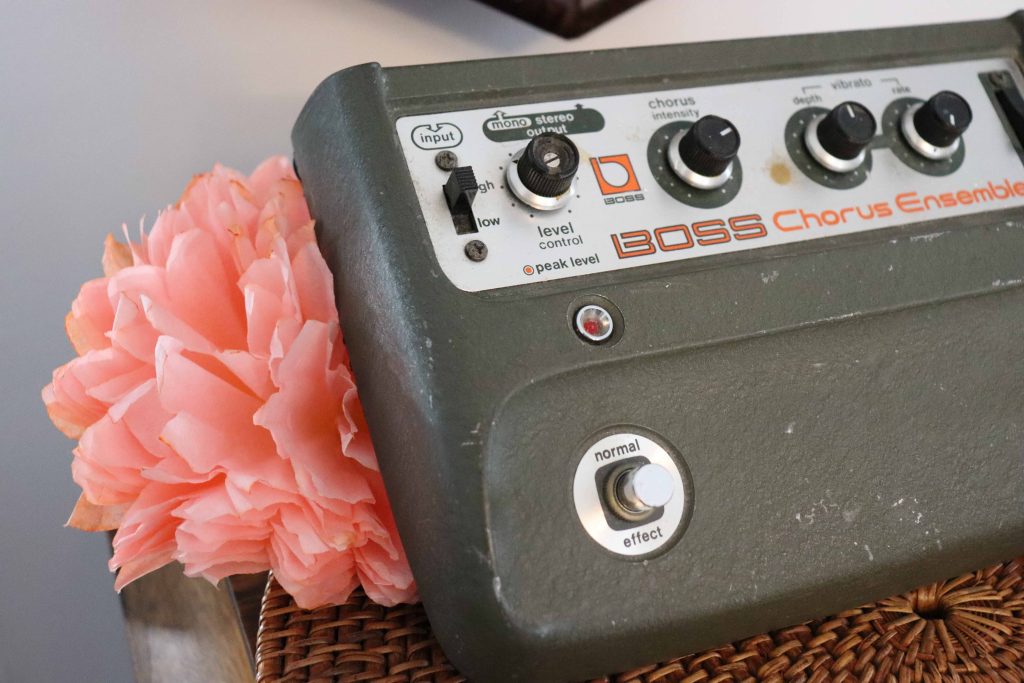
"BOSS pedals are so versatile."
With a lot of other pedals, you kind of just get it, and you’re like, “Cool, it does that one thing.” But the BOSS pedals are so versatile.
I mean, it’s the same thing with the PS-2. I use it as a slapback. And I use it for a long delay. Or I’ll use two of them at once; I might swell in chords using an octave below, and then I’ll turn on the octave above, so that it’s almost like playing organ and pulling out draw bars. I love the PS-2.
Which recent BOSS pedal releases are you most interested in?
I’d love to try the new PX-1 [Plugout FX]. It sounds amazing. I just got the [Roland] JC-40 Jazz Chorus amp and a BOSS Poly Shifter. I’m friends with Johnny Marr, and he always raves about the BOSS GT-1000 [Guitar Effects Processor].
Make a Beautiful Album with BOSS
Tell us about how you used BOSS pedals to record your new solo album, Tell a Beautiful Lie with Sound.
There’s a sound on my new record on the track “Your Life Is Waiting for You” which is just the BOSS [FZ-2] Hyper Fuzz and the PS-2 all the way up. It’s the BOSS Hyper Fuzz and the BOSS PS-2 doing that low octave rumbly kind of thing.
I mean, honestly, the entire album is pretty much all BOSS pedals. I shouldn’t say all; I mean a lot of BOSS pedals. I used the DSD-2, the RV-3, the PS-2, the RV-2, and the HF-2 Hi Band Flanger, which a lot of people don’t talk about… Now that I think about it, I don’t know if the HF-2 made it on the album. It might not have. But the RV-3 is on every song. And for delay, I’m kind of going back and forth between using the PS-2 and the DSD-2. I mean, it’s kind of like BOSS soup.
"The RV-3 is on every song. And for delay, I'm kind of going back and forth between using the PS-2 and the DSD-2."
Which other BOSS pedals do you own?
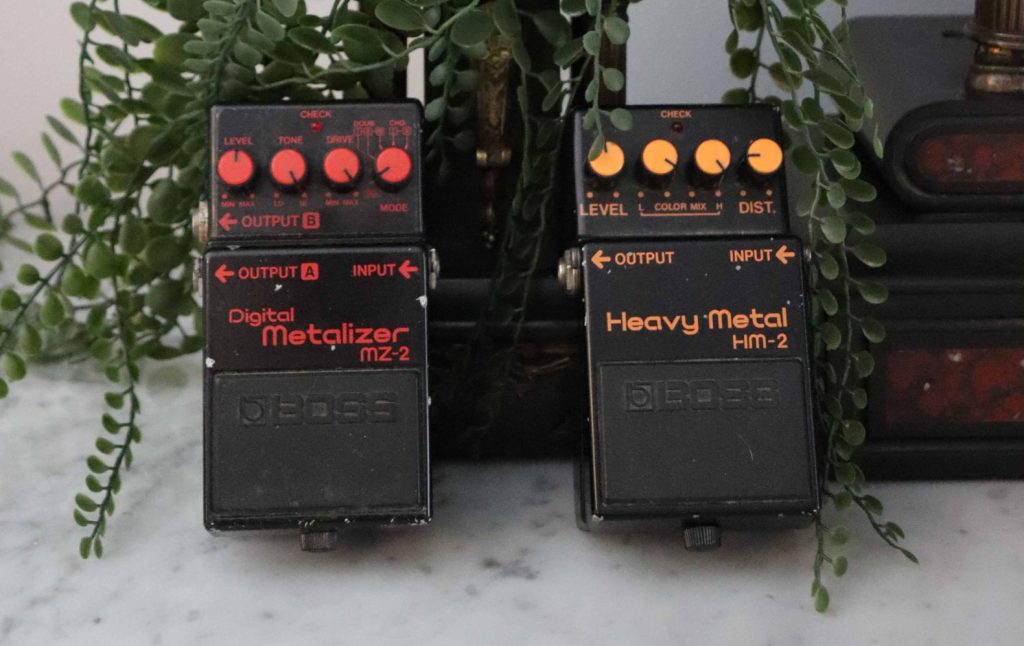
I have plenty of other BOSS pedals. I love the MZ-2 Digital Metalizer and the OS-2 OverDrive/Distortion. Those didn’t make the cut on Tell a Beautiful Lie with Sound, but my main color palette is BOSS pedals. I can get a really cool Bad Brains-style sound from the MZ-2—like the guitar tone on I Against I.
My buddy Nathan Larson from Shudder to Think put me onto the BOSS [HM-2] Heavy Metal pedal. I know everyone associates the Heavy Metal with the chainsaw Swedish death metal guitar tone, but I’ve gotten some interesting, cleaner, kind of broken-amp sounds with it.
I also love the OS-2. I have a secret setting where the [Color] knob is at about 2 or 3 o’clock, where the [OD and DS] blend sits nicely. I have the Drive just up a little bit. The OS-2 might be an exception to what I say about me using BOSS pedals in a million different ways. That’s how I tend to use the OS-2. That particular pedal is a go-to for me with that setting.
How did you control EQ during the recording of Tell a Beautiful Lie with Sound?
I used the BOSS GE-7 Equalizer to add a bit more stridency to the guitar tone. A big part of the sound on the record was that almost everything was direct. More than anything, I needed to boost the midrange because the Portastudio I have doesn’t have a midrange control; it’s just low and high.
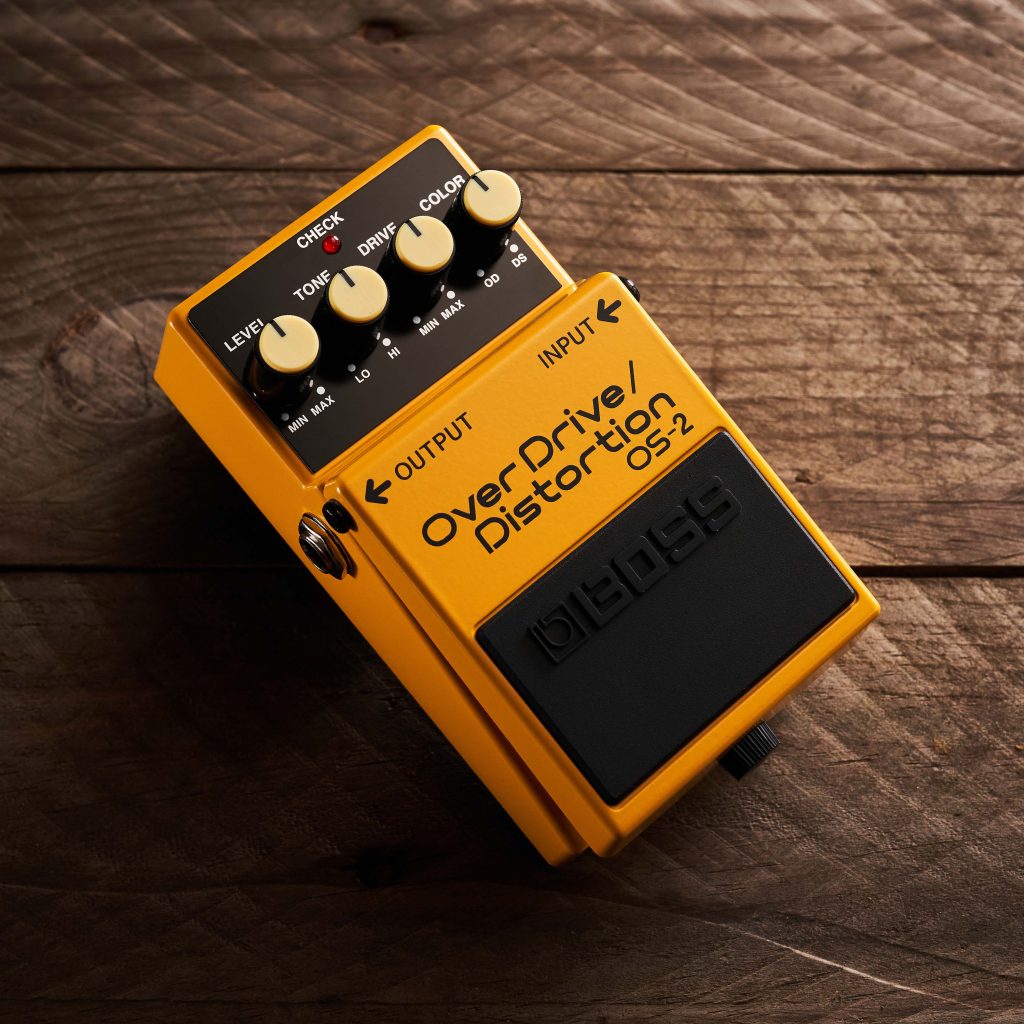

"My main color palette is BOSS pedals."
It’s funny. I think there’s literally only one song where I use the Portastudio preamp distortion—the song called “Transsexual Menace.” Anything else that might have dirt on it is really just coming from the BOSS Hyper Fuzz, or possibly the Ibanez [LF7] Tone-Lok Lo Fi.
I’m one of the rare people who doesn’t love the way that the Portastudio breaks up. I don’t mind it on maximum punishment—you know, all the way up. But when you get a little bit of dirt on it, I don’t like what it does to the bottom end. It just doesn’t sound good to me.
"I’m one of the rare people who doesn’t love the way that the Portastudio breaks up."
So Reel
What do you like most about the Tascam Portastudio 424?
What I love most about the 424 “mark one” in particular is its adjustable tape speed. With the slowest speed, it gets into shoebox recorder territory. It’s not quite as low fidelity as that—it’s just a cool color to have in there.
And I love the dbx [noise reduction function]. When you use dbx, you’re supposed to keep it consistent between recording and playback; you’re not supposed to record with it off then turn it on for playback, or record with it on then turn it off for playback.
But I sometimes like how it sounds when you break that rule; it’ll choke the sound in a cool way and compress it.
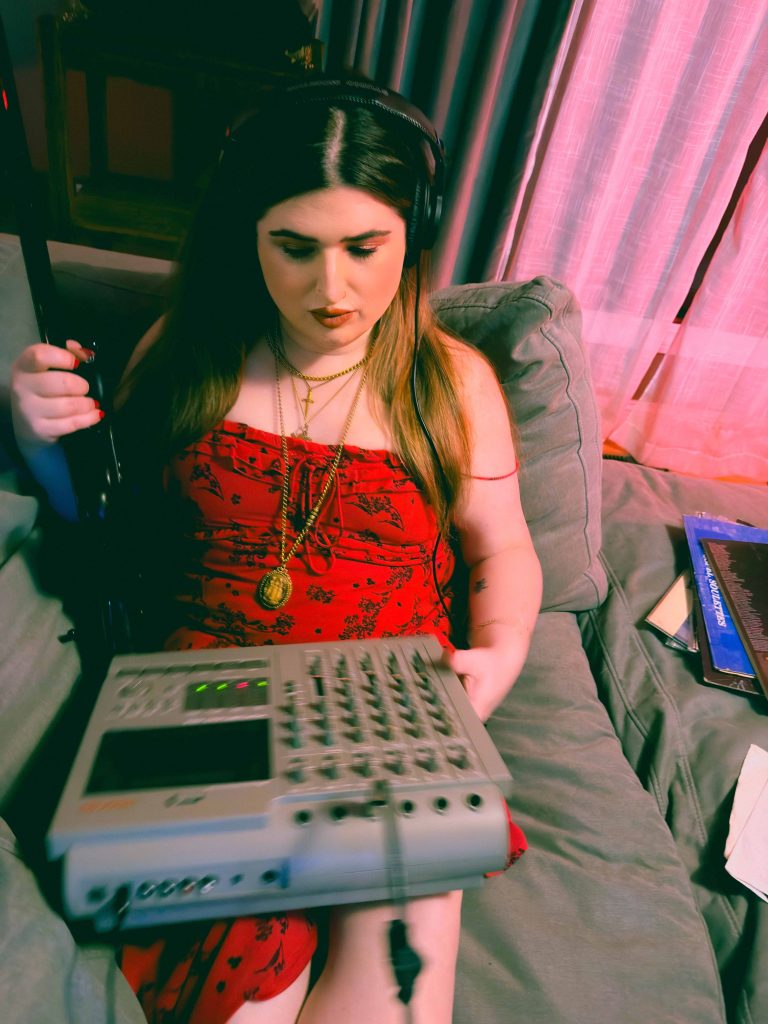
"What I love most about the 424 'mark one' in particular is its adjustable tape speed."
Flipping the tape over to create reverse sounds is fun. Also, using the pitch control, you can create a demonic, down-pitched voice by recording at high speed, speaking into the mic, and then returning to normal speed.
Because the Portastudio 424 has different speeds, you can do the opposite: pitch up by recording at a slower speed, then go back to normal. It’s an amazing instrument. I love the 424.
How did you achieve the bass sounds on Tell a Beautiful Lie with Sound?
I don’t think it’s a minimalist album, but I really went there with the least amount of stuff possible, and I didn’t even bring a bass. On some of the tracks, I used the PS-2 to pitch down and just turned the Balance knob all the way up [to 100 percent wet]. It gave me a very unstable kind of punk bass sound.
"A lot of the kick drum is me bashing the top of a [mic] with my palm and sending that through pedals."
What mics did you use to record Tell a Beautiful Lie with Sound?
Just a [Shure SM]58. A lot of the kick drum is me bashing the top of a 58 with my palm and sending that through pedals to add more bottom end, room sound, and distortion.
Did you find the limitations of using a Portastudio 424 creatively beneficial?
Yeah, I did. Recording on a four-track has inherent limitations. I only had four tracks to work with, and I wasn’t ping-ponging [bouncing] to open up more. So that, in and of itself, and using those BOSS pedals, was almost like playing an old Moog in the sense I wasn’t utilizing presets. I had to be present, shaping sounds in the moment.
I absolutely love working with limitations. I find I’m more creative because it helps mitigate decision fatigue. With a four-track, it’s like, “If you can’t say anything with four tracks, why do you need six?” You know what I mean? Like, “How is six going to make your idea better?”
"It makes me feel good knowing that house made music again."
House Music
What made you decide to go to Jeff Buckley’s old house to record?
I hadn’t done anything like before that I can remember, just in terms of going to an unknown place. I sort of felt like that house was calling me. I mean, I’m a big fan of Jeff’s music and, as I said, I know he went there searching for something.
I felt like I was searching for something too, and I wanted to see what it would feel like being there. It makes me feel good knowing that house made music again.
How much of the music did you prepare in advance? Was most, if not all of it, made in the moment?
Good question. I just had little kernels of ideas. God forbid I got there and had nothing to say, at least there were some ideas to fall back on.
But most of it was conceived in the house. I mean, for sure, the last song on the album [“Love Me All the Way Through”] was written the day I got there. That just came to me.
"Most of it was conceived in the house."
A lot of the tracks are improvisations I sculpted into songs. For example, “Your Life Is Waiting for You” was just two tracks of guitar, and that was it. I played it for Johnny Marr, and he had some suggestions I carried out, which turned it into this whole other beautiful, powerful thing.
Most of it was all done in the house. I mean, going there with a timeline, I had to make something happen. But it’s not the most gentle restriction to place on yourself in terms of creativity.
I was a bit scared because the house is a little spooky, but at the same time, I only had about 10 days to write and record all this music. I got good sleep, but there was a clock ticking.
"I told myself that this year was going to be the year I devoted to my own music."
Creative Goals
Did you set yourself any creative goals?
I told myself that this year was going to be the year I devoted to my own music. I turned down a big, long Sam Smith tour, which I was very honored to get the call for, but I just thought, “If I don’t start doing my own music, it’ll be this endless seduction of playing for other artists and making money, but never investing in my own sound.” I took a risk this year and, maybe it hasn’t paid off financially, but it certainly has emotionally.
Why is it important to record your own music?
It makes you immortal to write your own music and put it out. It’s there forever. Me playing with an artist is an amazing opportunity, but that doesn’t make me immortal. Nobody remembers that. But if you put out an album, it’s there forever. It really feels like that’s more of a legacy than going on tour with an artist or playing on a hit song.
"It makes you immortal to write your own music and put it out. It's there forever."
Did working on Tell a Beautiful Lie with Sound inspire you to pursue more solo recordings?
If I could, I would just write my own music and not work for other people. At least I’d be very, very choosy. But at the moment, I have to do a lot of different things to stay afloat financially—I play on records, have a Patreon, teach, and do some shows (though not many). I’ll do whatever needs to be done.
In a perfect world, it’d be great to just create my own music and live off of it. A lot of artists would agree. Then, I’d be sort of ultra-focused in terms of what collaborations I want to do with other artists, as opposed to, like, “I need to pay my bills.”
"Most people know me for being an R&B and funk rhythm guitar player on the Different Strokes for Different Folks album with Charlie Hunter."
Sound Lessons
What did you learn from making Tell a Beautiful Lie with Sound?
It was like going to therapy. It taught me about myself. When I put the music out and see how other people respond to it, I get to sit back and sort of check in with myself about the emotions I went through creating it—the doubts, the insecurities, all of those things.
Overcoming them feels different than playing for an artist and being nervous or whatever. With Tell a Beautiful Lie with Sound, it’s more like I’m believing in myself enough to put out music, even though I’m scared to.
I mean, Tell a Beautiful Lie with Sound in particular, is me—it’s music that I live, but it’s not music that people know me for. You know, I think most people know me for being an R&B and funk rhythm guitar player on the [Different Strokes for Different Folks] album with Charlie Hunter.
"Some of the stuff on Tell a Beautiful Lie with Sound is like guitar exorcisms. It feels like an incantation, a spell."
Some of the stuff on Tell a Beautiful Lie with Sound is like guitar exorcisms. It feels like an incantation, a spell. And people don’t know me for that sound. I was terrified that I was just going to alienate a lot of people doing that, and for other reasons too. But it’s real music to me that I’m living. It’s art. It’s me. So I had to put it out.
I don’t feel those kinds of emotions when I play on someone’s record. I feel like when I’m on someone else’s project, I’m just there to help. So it’s not as emotionally attaching. I just want to do a good job and help them with their music.
"I didn't realize how much of an influence John Frusciante was until I made Tell a Beautiful Lie with Sound."
Four-Track Freedom
There have been some really great albums made by guitarists using four-track recorders. What are some of your favorites?
One of the biggest ones for me was John Frusciante’s Niandra LaDes and Usually Just a T-Shirt. I bought that record when it came out in ’94. I still have it, and Smile from the Streets You Hold [released in 1997]. Just that rawness… Oh my god, it’s so direct. I mean, everything is as raw and honest as can be.
I grew up in the ’90s, so obviously the Chili Peppers are part of my history. But I really respect [John Frusciante’s] artistry, whether it’s an electronic record or something raw and angular. He just lives his art.
I didn’t realize how much of an influence John Frusciante was until I made Tell a Beautiful Lie with Sound—like how much his career path and the aesthetic of the four-track recorder influenced me.
"There’s always more to making music and needing to further express yourself."
Obviously, John Frusciante is a very famous musician in a very famous band. Whereas I’m a more behind-the-scenes musician who’s played with very famous people. But still, I can relate to that way of thinking—that there’s always more to making music and needing to further express yourself.
John Frusciante could probably just rest on his success from the Chili Peppers, but he’s a true artist with a need to create, and I respect that immensely. I don’t think any of my music sounds like his, but following his solo career over the last 30-plus years has been huge for me.
Johnny Marr is the same. Anytime I talk to Johnny, he’s always writing. He’s always working on something and tinkering with sound. Like, as artists, this is what we do, you know?
"I love Dinosaur Jr., Sebadoh, Sentridoh, and The Folk Implosion—all of Lou Barlow's projects. That aesthetic was really influential."
Lou Barlow was another big inspiration. I live in The Berkshires in western Massachusetts (in the mountains between New York City and Boston), which is kind of in the same area. I love Dinosaur Jr., Sebadoh, Sentridoh, and The Folk Implosion—all of Lou Barlow’s projects. That aesthetic was really influential.
Jeff Buckley is really important to me also—especially the side B tracks on his Sketches for My Sweetheart the Drunk. I was thinking about this last night. I mean, to some people, it can be a turn-off how real, raw, and up close it is.
With some of Jeff’s stuff—and especially John Frusciante’s Niandra LaDes and Usually Just a T-Shirt—you’re hearing these exorcisms in motion. It makes me think how important authenticity is in music.
"I like any kind of musician who might have tons of chops but chooses to express themselves as honestly as possible."
Unfiltered Genius
How do you personally connect with the music of John Frusciante, Lou Barlow, and Jeff Buckley?
I’m connecting with their search—finding things, and not worrying about perfecting everything. With Tell a Beautiful Lie with Sound, I wanted the emotion of what I’m trying to say to come across. I really value that. I mean, not to put other music down, but there’s a lot of other stuff that doesn’t do that, and it just doesn’t reach me.
Some of your influences are incredibly skilled, yet they prioritize raw expression over technical polish. How does that philosophy shape your own playing?
I like any kind of musician who might have tons of chops but chooses to express themselves as honestly as possible. Marc Ribot comes to mind. Same thing with Thelonious Monk. I mean, Monk could play super mean, and Bud Powell-like, and he’s just funky and raw.
A good analogy is like they’re driving a car that can go 300 miles an hour, but they prefer to go 30 miles an hour with the windows down, just cruising. Like they have the range and power, but they don’t need to show it off. I value that a lot in musicianship.