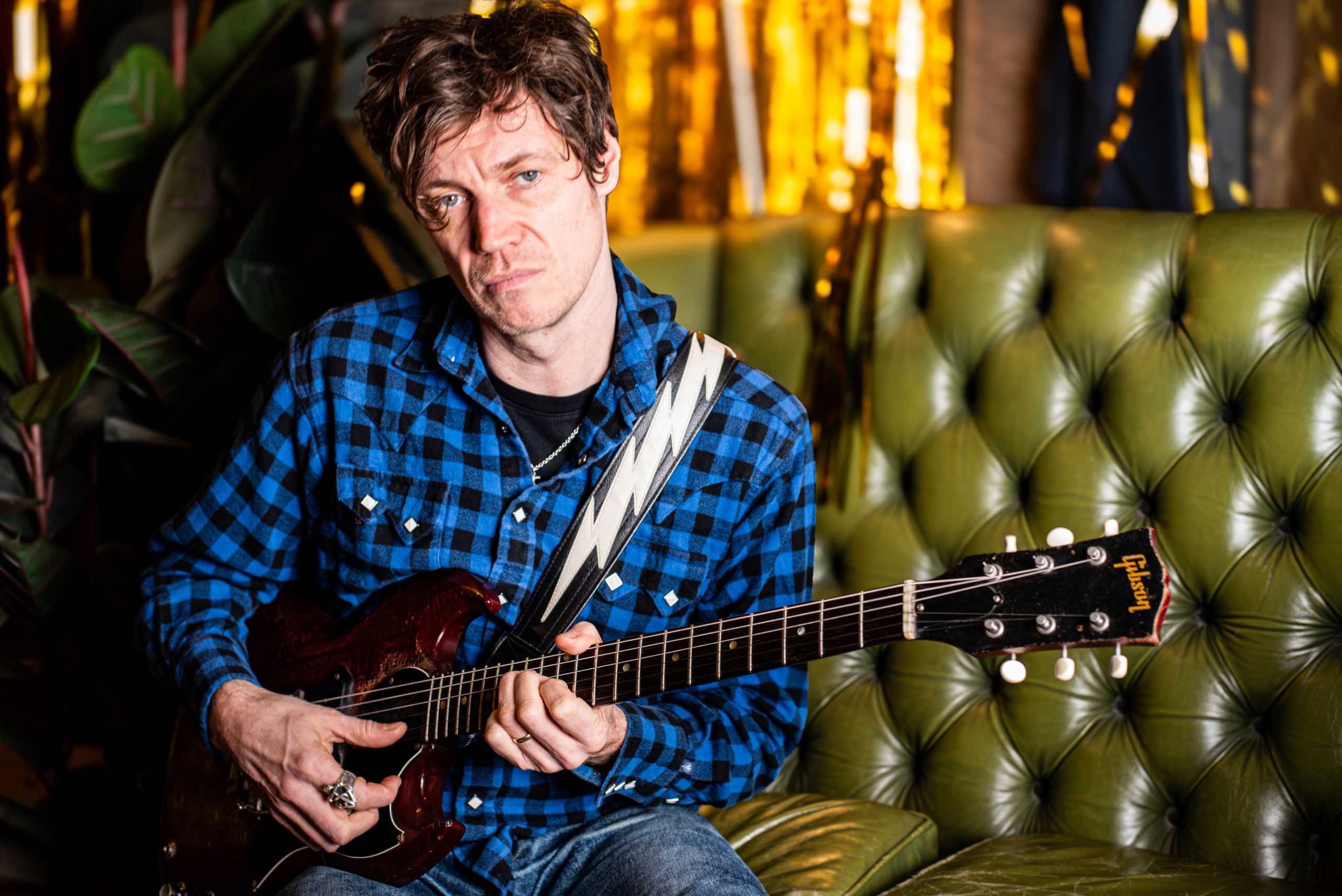


If the idea of a guitar hero still holds weight, James Walbourne makes a compelling case. Pretenders bandmate and Rock & Roll Hall of Famer Chrissie Hynde certainly thinks so, dubbing him a “hotshot” in a 2025 Guitarist cover feature. Underscoring that view, bestselling author and award-winning screenwriter Nick Hornby lauded his playing as “unearthly.” Hailing from Muswell Hill, North London, the dark-horse multi-instrumentalist has emerged as a formidable and omnipresent figure in the guitar world, his name surfacing repeatedly in conversations near and far. This owes, in part, to the gravitas of the role he’s assumed; as the Pretenders’ lead guitarist, Walbourne carries the formidable legacy of original member James Honeyman-Scott and ex-Smiths legend Johnny Marr.
The Great Pretender
Often cited as the Pretenders’ secret weapon, Walbourne is a driving force behind their creative resurgence. He has become a key member of the Grammy-nominated, platinum-selling band’s songwriting core, having forged an inspired artistic alliance with Hynde during the making of 2020’s Hate for Sale album.
Speaking to TotalNtertainment about the Pretenders’ latest LP, 2023’s Relentless, Hynde described their composition process as “honed down to an art,” adding, “He always comes up with something I wouldn’t have thought of myself.” They are currently focused on crafting their next album.
Versatile Virtuoso
Walbourne is no stranger to collaborating as part of a duo. You may also know him from folk-rock act The Rails, where he writes and performs alongside his wife, Kami Thompson, daughter of folk luminaries Richard Thompson and Linda Thompson. Together, they have earned critical acclaim and multiple awards. As The Guardian put it: “They’re the best folk-rock Thompson-affiliated duo since Richard and Linda.”
If high-voltage rock ’n’ roll is more up your street, then don’t miss His Lordship. Catch one of their jaw-dropping live shows, and you’ll witness Walbourne’s six-string virtuosity full tilt. Formed with Pretenders drummer Kris Sonne during lockdown as a back-to-basics, hard-rocking two-piece, the outfit embarked on a sold-out debut tour in 2022. Keep an eye out for His Lordship supporting Johnny Marr later this year.
Chemistry and Charisma
In addition to Pretenders, The Rails, and His Lordship, Walbourne has contributed to numerous albums as a sought-after session musician. His list of credits is extensive and features an eclectic mix of artists ranging from Peter Bruntnell, Edwyn Collins, and Jerry Lee Lewis to Death in Vegas, Saint Etienne, and Soulsavers.
For this guitarist, live performance sits at the very heart of music. Coming of age on the London pub circuit, Walbourne is a magnetic frontman, overflowing with charisma and instinctively drawing audiences in. “There was nothing better than going into a pub and watching a band,” he tells us.
Also a striking solo artist in his own right (check out the debut album, The Hill), live performance for Walbourne is more than a means to an end—it’s a way of life. His impressive gig résumé includes the likes of fellow Muswell Hillian Ray Davies of ’60s trailblazers The Kinks, not to mention North London Celtic punks The Pogues.
Drawing on years of experience, Walbourne has plenty to share with fellow musicians like you. And when BOSS dropped by his London studio, he offered us behind-the-scenes insights and fascinating tales from a life in music.
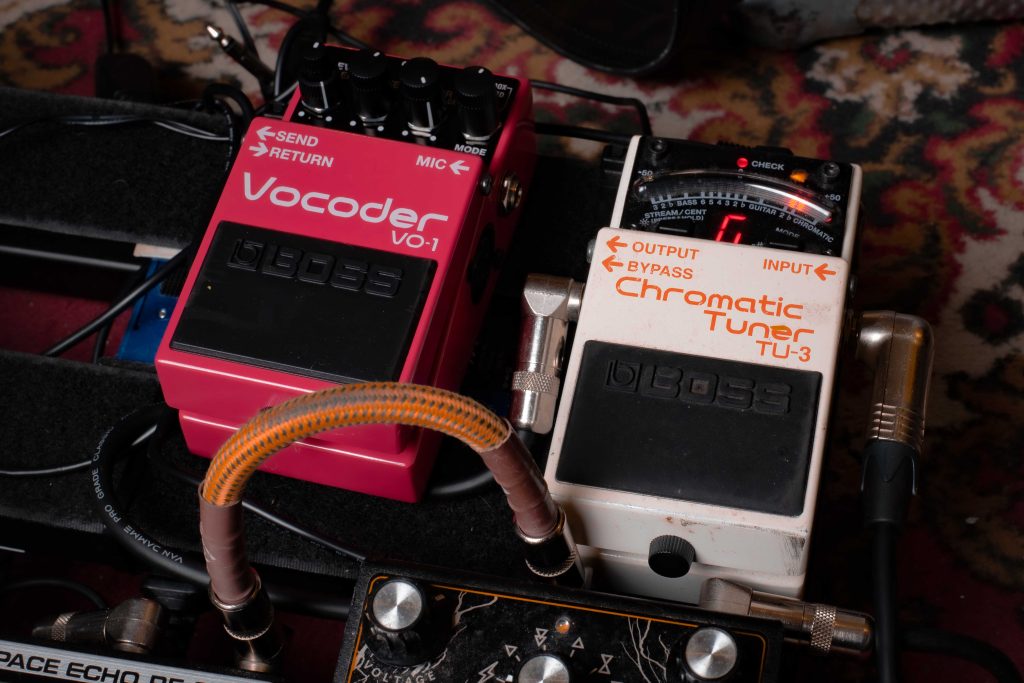
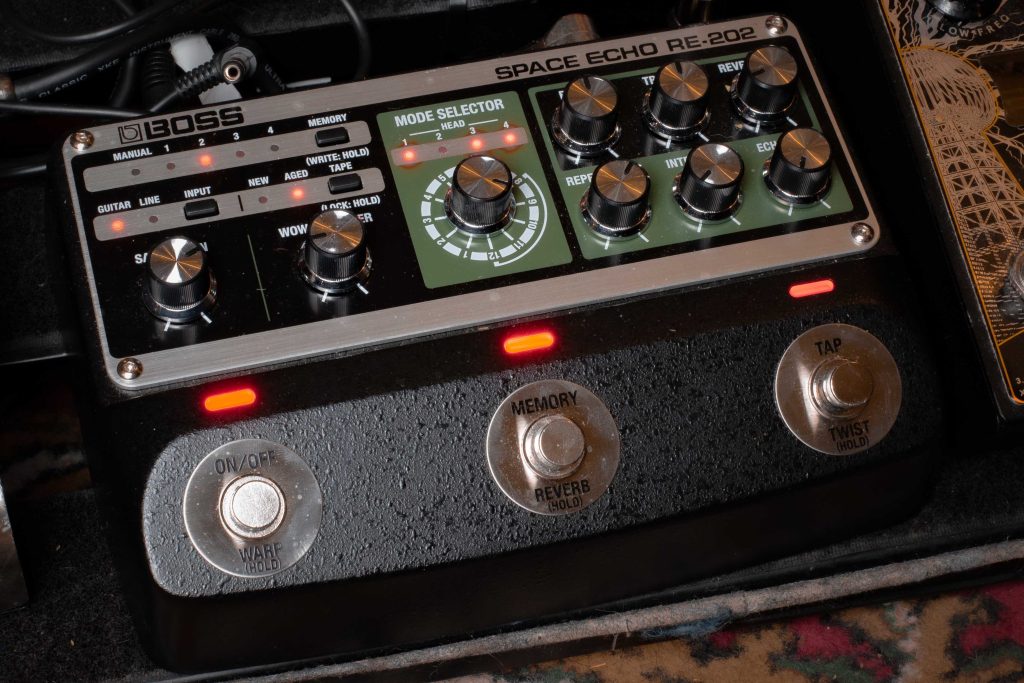
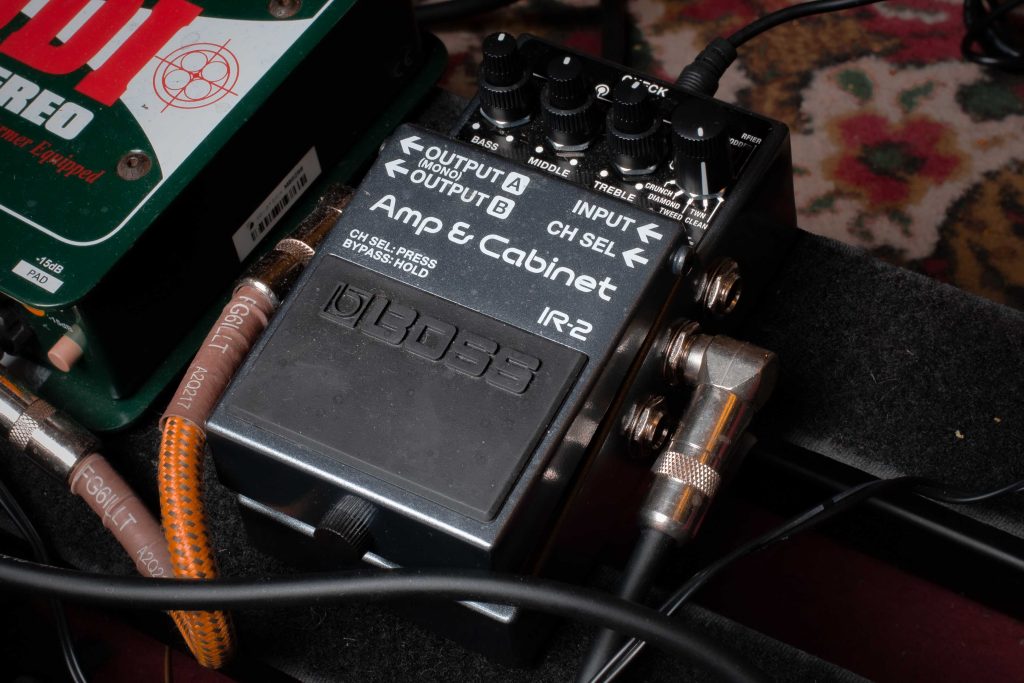
A longtime BOSS fan, Walbourne’s pedalboard caught our eye immediately. Loaded with the IR-2 Amp & Cabinet, RE-202 Space Echo, VO-1 Vocoder, and TU-3 Chromatic Tuner, his stompbox choices suggest a guitarist who demands versatility, reliability, and world-class tone.
Read on to explore the creative world of one of today’s most exciting guitar players.
Rock ‘n’ Roll Reboot
The new studio looks great. What have you been working on in here lately?
Thanks! We’ve just made a Chuck Berry tribute album here, which has been great fun. We’d listen to the original recordings and say, “Let’s try it differently.” We worked ourselves hard and recorded 14 songs in eight days. It’s been a brilliant experience, and now we know this studio really works for us (including the new His Lordship record).
"I used the VO-1 Vocoder here and there. It’s great. It sounds like Kraftwerk meets Chuck Berry."
Which BOSS pedals did you use to record the Chuck Berry record?
I used the VO-1 Vocoder here and there. It’s great. It sounds like Kraftwerk meets Chuck Berry. If you sing into a mic plugged into the VO-1 and play along at the same time, you get instant Peter Frampton. I’m definitely going to use it live. I’ve only got the talk box thing down with it so far, but I know it can do a lot more.
I like having unique stuff like the VO-1 lying around. It’s the sort of effect that you probably wouldn’t put on every song on an album, but is perfect for a few things. Some instruments are like that, too. A six-string bass, for example, can be a great choice at the right moment.
Jamming with Johnny
Aside from a new album, what’s in the pipeline with His Lordship?
We’re doing SXSW 2026 in March, followed by a West Coast run with Johnny Marr. I know Johnny through Chrissie. We played Glastonbury in 2023, and he did some songs with us, including “Tattooed Love Boys.” Dave Grohl was on drums. It was great fun. We had some time to rehearse at John Henry’s in London beforehand.
It was a pleasure hanging out with Johnny. He’s very inspiring and gracious with his time. He will talk about music and just life in general—everything under the sun. We spent a few days playing and talking. He’s been a real champion of His Lordship. I’m grateful to him for that. He’s like that with everyone. It’s something to aspire to.
"It was a pleasure hanging out with Johnny Marr... We spent a few days playing and talking. He’s been a real champion of His Lordship. I’m grateful to him for that."
Marr’s Machines
Did you pick up any gear tips from Johnny Marr?
He got me onto the BOSS RE-202 Space Echo. It’s really versatile. You can do an awful lot with it. I mainly use it for slapback delay. I’m always looking for that classic rock ‘n’ roll slapback sound, which the RE-202 does really well.
You can get some pretty wild sounds with the different tape head combinations, and I love the Warp and Twist functions, which I’ve used live. I like the spring reverb sound, too. It can be pretty intense, so I tend to have it set fairly low.
"Johnny Marr got me onto the BOSS RE-202 Space Echo. It’s really versatile. You can do an awful lot with it."
Johnny also recommended the BOSS IR-2 Amp & Cabinet, which I’ve been using constantly. When I first plugged it in, it made a massive difference immediately. It makes my guitar sound come alive when I use in-ears. I got a great sound with the IR-2 straight away; I didn’t need to mess around with it much at all.
The IR-2 is basically the on-stage sound in my ears. I have a DI, and the amp goes out front. It gives the sound guy much more control. It also means we can have lower volume on stage, so I can hear myself sing better. The IR-2 is brilliant. I’ve been using it for everything.
"Johnny also recommended the BOSS IR-2 Amp & Cabinet, which I’ve been using constantly. When I first plugged it in, it made a massive difference immediately."
BOSS Essentials
Of course, no pedalboard is complete without a BOSS Chromatic Tuner.
The TU-3 Chromatic Tuner is a staple for every guitarist. You cannot do without it.
Are there any other BOSS pedals that interest you?
BOSS chorus is another thing I’ve been really interested in recently because of James Honeyman-Scott, the original Pretenders guitarist. He used the first chorus pedals—the big CE-1 Chorus Ensemble and the CE-2 Chorus.
Chorus is a unique sound I really want to delve into. It’s on classic Pretenders songs—all over some of them. I was a bit unsure about using it when I first joined the band, but I’m a fan of chorus now.
"BOSS chorus is another thing I’ve been really interested in recently because of James Honeyman-Scott, the original Pretenders guitarist."
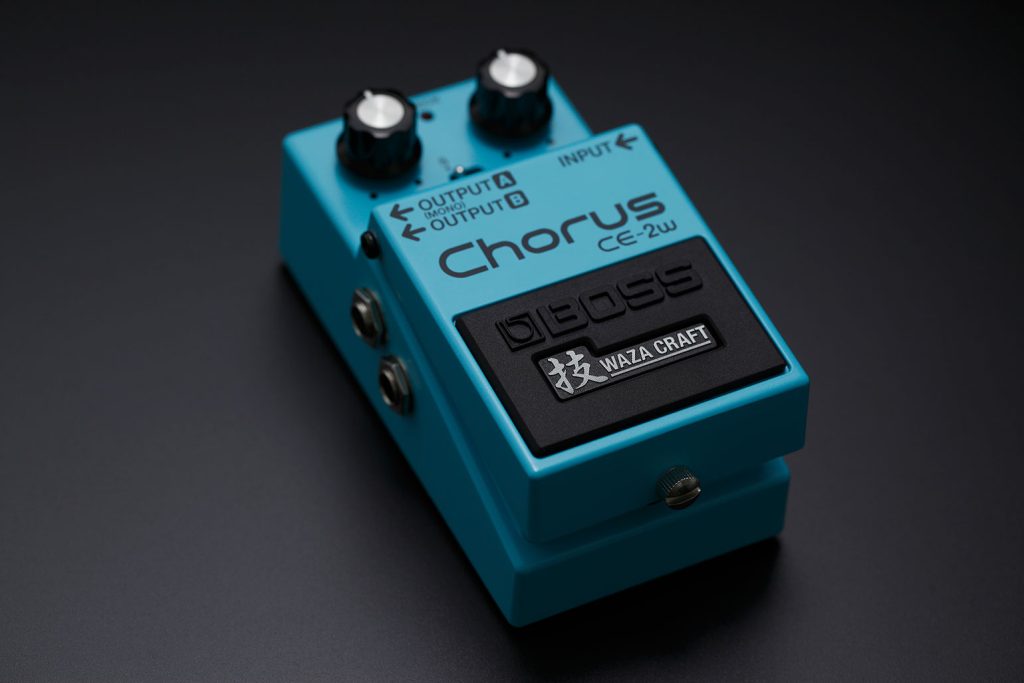
The CE-2W Chorus is a great pedal, and super easy to use.
Yeah, I sometimes get stumped by complex pedals—how to program them. But people like Johnny Marr and Troy Van Leeuwen, who use them properly, can get some really great sounds. I’m definitely more of a plug-and-play guitarist. That’s why I like a lot of the older BOSS pedals.
What are some of the older BOSS pedals you used?
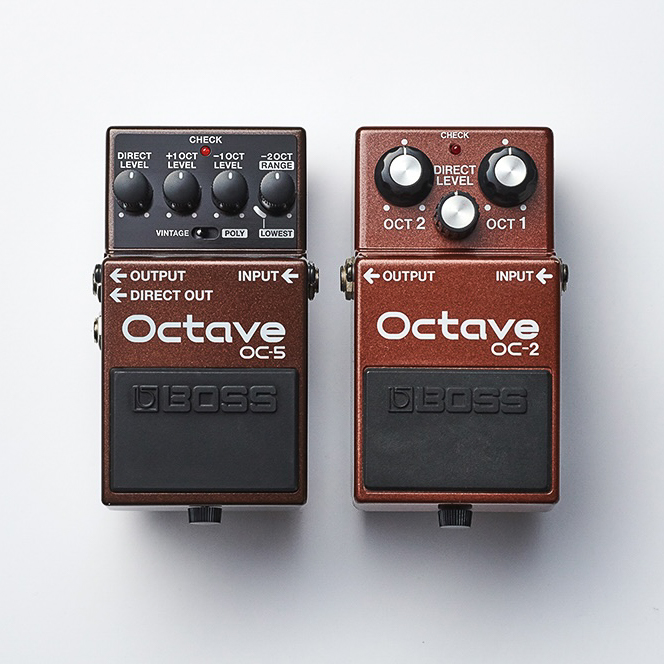
I used to use a CS-3 Compression Sustainer all the time, mainly as a solo boost. I don’t know why I did that—it’s quite strange! I also used to use an OC-2 Octave because I wanted to sound like Neil Young. He’s the pinnacle of a certain type of guitar playing I love. He’s my number-one influence.
My playing has an edge of chaos. You only have to take a look at my pedalboard to see how chaotic I can be. It always changes. My Pretenders board is different again. I don’t like using too many sounds because I find that it can suddenly start to bloat.
"I used to use a CS-3 Compression Sustainer all the time... I also used to use an OC-2 Octave because I wanted to sound like Neil Young."

P-90 Perfection
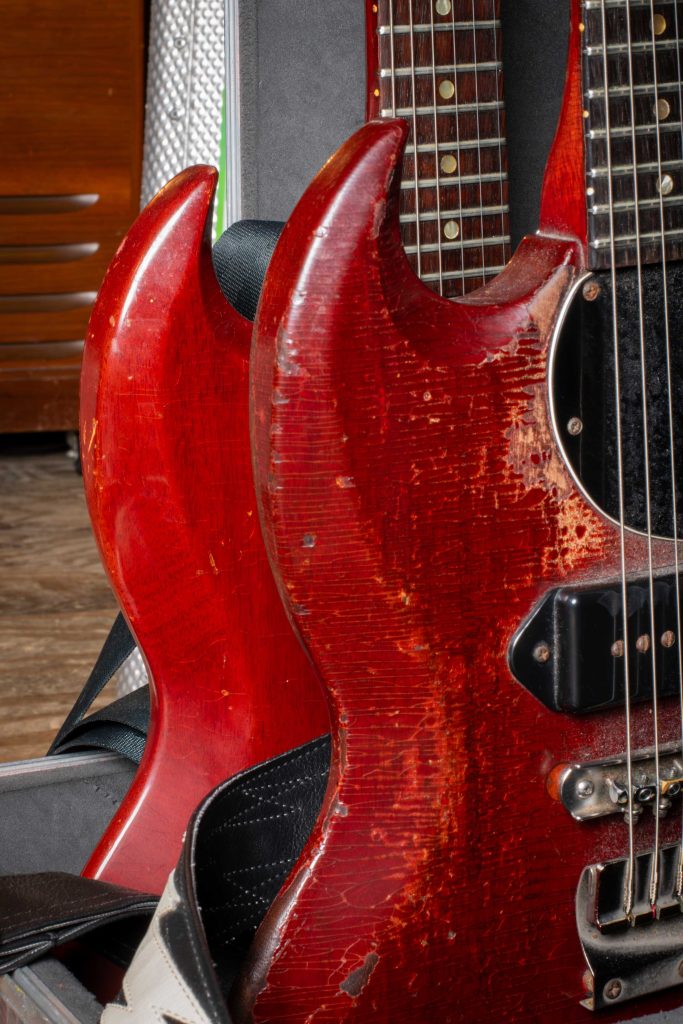
You get an incredible range of sounds out of your single-pickup 1963 Gibson SG Junior.
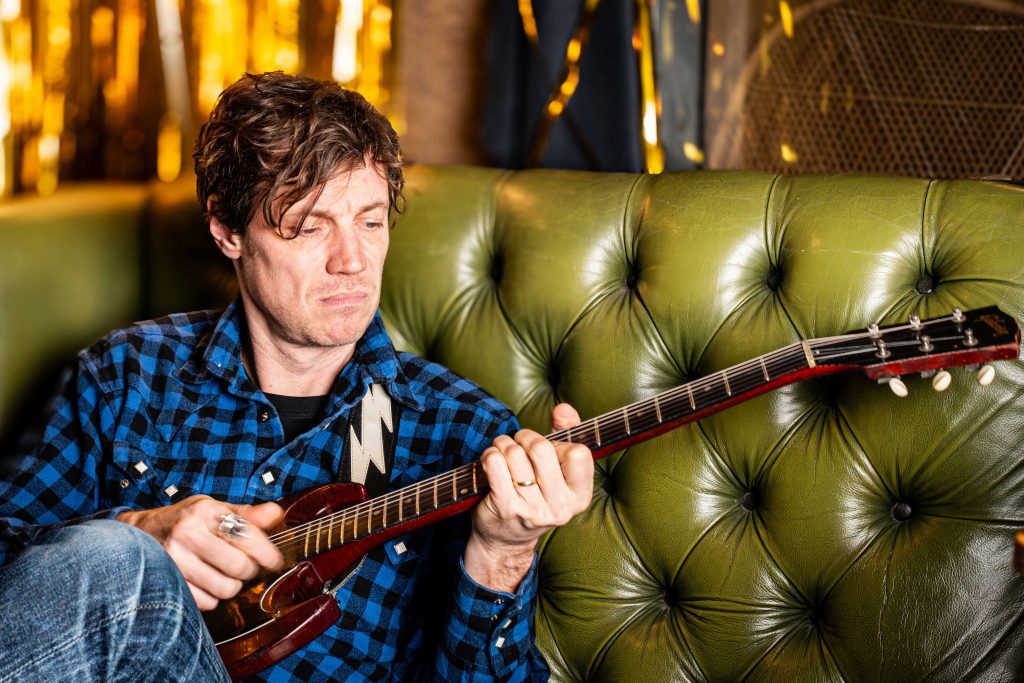
The Junior is an amazing guitar. The best thing about it is the single P-90 pickup. You can get a lot out of it. It’s a bit like my pedal selections: the simpler you keep it, the better, I find. I stumbled upon it by chance, during the first Pretenders record I did [2008’s Break Up the Concrete] in LA. They hired a ridiculous number of vintage guitars, but I just played a Junior throughout the whole thing.
I’d never played one seriously before, and I don’t really like the look of them that much, truth be told. It would never have been my first choice, but it was undeniably great. When I got back to London, my pal Andy Hackett had this one in his shop, Angel Music, for a couple of grand, which I bought. I’ve played it ever since.
Chuck Berry’s Birthday Bash
The SG Junior works really well for Chuck Berry songs—how did this recording project get started?
In October 2025, I did a show in St. Louis, [Missouri], his birthplace, called Chuck Berry’s Birthday Bash, to celebrate his 99th birthday. It was with the St. Louis Symphony Orchestra, which was very difficult as a guitar player.
We also had Doug Wimbish and Will Calhoun, the rhythm section from Living Colour, playing with us. [The Rolling Stones’ saxophonist] Tim Ries and The Stones’ singer Chanel Haynes were there, also. Bobby Floyd, the keyboardist, too. I mean, they were all amazing players.
I ended up singing a load of songs. Chuck Berry’s wife, Themetta [Suggs], was there to see the show, and I got to know his son and grandson. Suffice to say, I went deep into Chuck’s music, and it was great to reconnect with it. He was one of the main architects of rock ‘n’ roll and a true original.
Rock ‘n’ Roll Mastery
What was it that struck you about the music of Chuck Berry?
I discovered it’s all about the lyrics and songwriting. But you can’t really do a tribute that’s as good as Chuck himself. So, that begs the question: how do you approach it? It was all about his personality. The songs were so… him! It was a period of soul-searching. I mean, you can’t just do a Chuck Berry impression.
I began asking myself how His Lordship could write songs in a similar vein. We had to simplify them, which was really difficult. The takeaway was: rock music is difficult. It’s not an easy thing to do. Constructing a song that sounds simple and having the guts to cut it back is tough. It’s way easier to keep adding more.
"Being able to axe your own ideas is key to being in a band."
How important is it to be able to “kill your darlings”?
Being able to axe your own ideas is key to being in a band. If you can do that and not get the hump when someone says, “I don’t like that bit,” that’s an advantage. It took me a while to get there.
You get so much work done if you can be like that. Obviously, you can keep the bits you really love for something, but if you’re in a band, it’s good to be able to move on. I have a strong working relationship with Kris like that.
Pretender to the Throne
You’ve also built a strong working relationship with Chrissie Hynde. Tell us how you got the Pretenders gig.
[Pretenders founding member and drummer] Martin Chambers and I have a mutual friend we used to be in bands with called Peter Noone (not the Peter Noone from Herman’s Hermits, though!) We would play every week at a pub in North London called The Boogaloo. Martin only lived down the road in Crouch End, so he would come up and watch us.
"Chrissie came over to my house, and we played through a couple of songs. Next thing, I was on my way to Palm Springs [in California] for a kind of trial show. We hadn’t even rehearsed all the songs!"
At the time, I didn’t know much about the Pretenders at all. But one Christmas Eve, I’d flown back from Dublin after a gig with The Pogues, and we were all standing around the carousel waiting for our bags when Martin called me. He said, “We need a guitar player. I’ll give you a call in the New Year,” then hung up.
True to his word, he called me. I met Chrissie in a vegetarian restaurant down in Marlebone [in London]. She came over to my house, and we played through a couple of songs. Next thing, I was on my way to Palm Springs [in California] for a kind of trial show. We hadn’t even rehearsed all the songs!
It sounds like your first gig with Pretenders was pretty challenging.
Yes. Especially because on the journey there, the airline lost all our gear—all my pedals and guitars! But thankfully, we quickly got a bunch of BOSS pedals together.
How did it feel as a new member of the band?
When you go into any new band, you go into their private world. It’s a whole ecosystem. Chrissie would just throw songs up on stage that we hadn’t even played before, so some of it was a bit scary. She still does that.
"The airline lost all our gear—all my pedals and guitars! But thankfully, we quickly got a bunch of BOSS pedals together."
But the thing is, I just love playing. I only feel nervous on stage if I’m out of my depth. For example, suddenly being asked to read music with the St. Louis Symphony Orchestra at the Chuck Berry concert was difficult. I wanted to be a bit wild and couldn’t. But I know what I’m doing in most situations.
A producer once called me “a chancer.” It was really funny because I thought, “Yeah, sort of.” But I can play with a rock ‘n’ roll band and keep up, no problem. I’m very comfortable in that scenario.
Live Lessons
Does that natural ease come from having played live in pubs so regularly early on?
Absolutely. I learned everything from that: slowing down, stops, communication, watching for signs and body language, and how to lead a band. There’s a whole set of subtle cues. You have to go through that process, or you’ll never learn. You could call it stagecraft. I learned so much about that from Chrissie later on as well.
I used to play live in pubs all the time. I used to have my own three-piece blues band, and we’d play pubs every weekend. Dodgy pubs as well, full of customers who didn’t always want to hear us play. But even that was worthwhile. You learn something from everything.
"I used to play in dodgy pubs full of customers who didn’t always want to hear us play. But even that was worthwhile. You learn something from everything."
How important is it for a band to play live?
You can play in a rehearsal room for years, but if you don’t play a gig, you’re not seeing the whole picture. You could rehearse for weeks, then go and play, and it’ll all go wrong. Sometimes, you’re almost better off just learning the songs for a couple of days, then going out and performing them.
That’s where you learn: playing shows in front of people. It’s different from rehearsing. You could get it just right—all your pedal and amp settings, then get to a gig and suddenly find it’s all completely wrong. Or maybe a piece of gear goes wrong, which is all too common.
There are all these factors to consider, and you can’t be prepared unless you get out there and play. That’s my experience anyway.
"You can play in a rehearsal room for years, but if you don’t play a gig, you’re not seeing the whole picture."
Comfort Zone Conquests
Can you describe any live situations that brought you out of your comfort zone?
Playing with the St. Louis Symphony Orchestra is a good example. I had to use in-ears because the amp was set so low. Like, “How can I do Chuck Berry if my amp’s so quiet?”
That, and trying to keep up with an orchestra, isn’t something I really want to experience again. It was hard. But I know what it entails now. I learned from it.
"Trying to keep up with an orchestra isn’t something I really want to experience again. It was hard. But I know what it entails now. I learned from it."
Have any recording sessions pushed you out of your comfort zone in the same way?
When I did a jazz record with Chrissie [called Valve Bone Woe, her second solo album released in 2019], I said, “You should get someone else because I don’t really play jazz. You should get a much better guitar player who knows all those jazz chords.” She said, “No, I want you to play because you’ll bring something different,” so I agreed.
We were recording in Air Studios in London the next day, so I did a crash course in jazz chords the night before. I had the music, so I got all the chords together and started figuring it out. I’d write things down like “Jimi Hendrix chord” or “Chuck Berry thing” to remind myself. I learned loads of stuff in a single night.
It’s interesting what you can do if you put your mind to it. We took it to the Hollywood Bowl and did it live with an orchestra. I was the most nervous I’d ever been. I had to start the whole thing off. I wasn’t fully confident, but I learned so much from it. I used some of what I’d learned to co-write the next Pretenders record.
"Someone recommended using Logic... It completely opened up my songwriting.
Sonic Sketchpad
What tools do you use for songwriting?
I had a big breakthrough with Logic in 2015. Before that, I didn’t have much gear—everything was written on an acoustic guitar with one microphone. It was quite frustrating.
Someone recommended using Logic because it has a lot of virtual instruments, and it completely opened up my songwriting. Suddenly, I could hear a melody with, say, Mellotron sounds. I was instantly transported to different places where I could write more. It blew my mind.
Did Logic help speed up your songwriting process?
For me, Logic made songwriting very quick. My first Pretenders record writing with Chrissie Hynde [Hate for Sale] was the first time I used it in a major way. I used it to make quick demos. I worked really fast. I didn’t have any grand designs for it being the finished article, but it was amazing for songwriting—making sketches of songs.
I’m writing again with Chrissie at the moment for a new Pretenders album. I don’t seem to be travelling as much this year, so it’s a good time right now. It’s a good time to sit there with my friend Logic.
"I’m writing again with Chrissie at the moment for a new Pretenders album... It’s a good time to sit there with my friend Logic."
Songwriting Synergy
How does your songwriting collaboration with Chrissie Hynde typically work?
The way I write with Chrissie is that she’ll send me lyrics. I’ve got hundreds of ideas. I’ll wake up in the morning to emails of lyrics. I’ve got a folder of lyrics I’ll go through, and if something takes my fancy, I’ll just write a song to it.
Her lyrics are often brilliant. And if something speaks to me, a song will spring out. With Chrissie, it can be instantaneous. Which is an odd thing.
How do you know when a set of lyrics is ready to become a song?
It’s almost pre-formed. The melody just appears. For example, I knew the song “Hate for Sale” was going to be a thing straight away. I immediately knew how I would approach it.
When inspiration strikes, how do you go about building a song?
I demo it quickly on Logic, send it to Chrissie, and get her feedback. A bit later, I’ll do the whole song as best I can, then we’ll get together further down the line and knock it into shape.
"As soon as we started to write, the creative tap was fully on."
It took a while to start writing with Chrissie Hynde—what helped you unlock your creative flow?
I’d been in the band for about ten years before we even began to think about writing together. I was very cautious about it at first, but as soon as we started to write, the creative tap was fully on.
It took a long time because we were both kind of scared of going there. We didn’t want it to impact the relationship we’d built. Now, we’re very relaxed about it. It’s enjoyable.
How did you broach the subject of writing together?
We would always talk about it, but never really do it. One day, I said, “I’ve got this melody,” and showed it to Chrissie. She said, “That’s good. Shall I write some lyrics?” I said, “Of course!”
It started with the song “You Can’t Hurt a Fool,” from Hate for Sale. That was the first one we wrote together. I already had the title; it was from a book I was reading. We thought it was a great title. Chrissie wrote lyrics, and then I wrote a song for them. That was how it started.
"It started with the song “You Can’t Hurt a Fool,” from Hate for Sale. That was the first one we wrote together."
Creative Growth
How has your songwriting evolved over time, and what have you learned from writing with Chrissie Hynde?
After writing with Chrissie, my confidence grew. I wasn’t really confident for a long time, even after having written records with my wife in The Rails. I’ve definitely gotten better at it. Songwriting is one of those things that improves the more you do it. I don’t think about it too much. If you’re inspired, you’ll be okay. It’s all about keeping inspired.
How do you stay inspired?
It’s about feeding your imagination. I’ll go to the theatre and galleries, read and watch films. Reading is the biggest one for me. You need to try living the creative life. I’ve read more books since coming off Instagram. I’m picking up new books all the time.
I’ve just finished a Martin Amis book called Time’s Arrow. I also read the latest Ian McEwan book, What We Can Know. It’s about habit. In the morning, the first thing I do is make a cup of tea and read.
"You need to try living the creative life. I’ve read more books since coming off Instagram."
Industry Insights
What’s your take on social media?
Some people are great at social media, but it takes up a lot of time. The question is: should I spend my time on that, or should I concentrate on writing music?
It’s a bit of a chicken-and-egg situation. The music industry expects artists to have a huge social media footprint, but should the whole thing really be about that? I’m not sure it’s healthy for musicians and songwriters, young or old, to have to deal with that on top of everything else that’s thrown at them.
What do you think is essential for success in the music industry?
There’s an element of luck when it comes to meeting the right people. But that’s much more likely if you work hard. It’s true that you make your own luck.
When I was at school, I went to a careers event. There was a woman from a record company there, and one of the dads asked her how to get into the music industry. She just said it was important to go out to pubs and clubs and meet people. But the bloke didn’t want to hear it.
He got so aerated, like, “What do you mean? There must be a different route in!” She just said, “Not really.” I don’t know about now, but back then, going to see bands was how I met everyone.
"There’s an element of luck when it comes to meeting the right people... It’s true that you make your own luck."
Keeping it Real
How important is it to have the confidence to put yourself out there as a musician?
At some point, you need a leap of confidence. I surprised myself. I was painfully shy as a kid, and I found it difficult to introduce myself to people. Having a couple of pints or whatever helped. Not that I want to encourage people to do that, but my truth is that going to pubs and meeting people was massively important.
You could stay in your bedroom playing forever and be the best unknown guitarist in the world. But, at the end of the day, if no one has heard you, then what’s the point? If you’re happy with that, fine. I suppose there’s Instagram, but how significant is it in meaningful artistic terms? And are the audience expecting to hear real music? If you value those things, it’s worth questioning.
"There’s Instagram, but how significant is it in meaningful artistic terms?"
Creative Community
What role did playing with others and connecting in music communities play in shaping you as a musician?
You need to be able to play well and with others—and I mean in a room with people. When I was growing up, there was no YouTube or social media, so you had to leave your bedroom to connect with other musicians.
Music shops were a good place to meet people. I met so many musicians in Angel Music. I worked there for a bit when I was 19 and 20. I took [guitarist] Gem Archer’s job when he joined Oasis.
"Music shops were a good place to meet people. I met so many musicians in Angel Music... I took Gem Archer’s job when he joined Oasis."
Robbo [Brian Robertson] from Thin Lizzy came in on Saturdays to work with me, and we’d just play. This guitar shop was the hub, and absolutely everyone would come in. It was known as the party guitar shop. It was big for me growing up. It’s where I met a lot of people. That’s where I met Martin Kelly, my manager. It was a big community. But it’s gone now. The same thing is happening to music venues. It’s a shame there are fewer around these days.
There was nothing better than going into a pub and watching a band. They could be the best or the worst band, but to just see actual humans getting together and playing music was great. I mean, that’s how I learnt. It’s massive. The whole community thing is not as prevalent now.
Hub of Talent
Didn’t His Lordship form in a pub?
Yeah. We started in The Boogaloo. We didn’t have a preconceived idea about the type of band we would be. I met Martin Chambers in there, along with Shane MacGowan and Spider Stacy from The Pogues.
The Boogaloo was a proper music hub. The guy who owns it, Gerry O’Boyle, made it a brilliant musical place, and we were the regular band in there. Everyone passed through there, whether it was a literary event or a gig.
"I’m so grateful to have met Shane MacGowan, along with a ton of other fantastic musicians, at The Boogaloo."
Shane would just be there. We’d sit with him for hours talking about music and playing together. It was a great education. I’m so grateful to have met him, along with a ton of other fantastic musicians, at The Boogaloo.
We had a band that would play every Sunday. My brother would play drums. It was a debauched Sunday afternoon, and it would just go on and on. It was really my friend Bap Kennedy’s thing (the Irish singer-songwriter). He worked with Steve Earle and other incredible artists, including Van Morrison, Shane MacGowan, and Mark Knopfler. Bap passed away back in 2016, which was a real blow to all who knew him.
Fast forward many years, and I was between tours. I thought, “I’ve got to do something. Let’s get a band together and just play some rock ‘n’ roll.” So, we did just that, and Kris Sonne jumped in. It just came about naturally. Playing at that intensity was just how we were.
We carried on, and we’d get loads of people in—musicians like [Stray Cats drummer] Slim Jim Phantom and [original Sex Pistols bassist] Glen Matlock. Chrissie [Hynde] came along, and [Sex Pistols drummer] Paul Cook was there, too. There was a real community of musicians who showed up every Sunday.
"Slim Jim Phantom, Glen Matlock, Chrissie Hynde, Paul Cook... There was a real community of musicians."
We thought, “This is quite good. Let’s write a couple of tunes,” and now, we’re here. The first tune we wrote was “All Cranked Up.” That’s the song that got us on the radio first. It was a surprise because it was the first band I’d been in where I hadn’t cared about success. I mean, it was primarily for us to have fun. That’s when I realized not caring was key.
That’s Entertainment
How do you approach performing for a live audience?
Entertainment is the rule. His Lordship is kind of old school in that regard. That’s one of the reasons we started. During lockdown, I was so sick of hearing dreary acoustic sets through a computer. It felt like an intense rock ‘n’ roll show was a little bit rare. At least I didn’t see it much around that time.
If we’d have done this 20 years ago in The White Stripes era, it wouldn’t have seemed so rare, but intense rock ‘n’ roll shows are almost an oddity now. There are great young bands out there, but they seem to be less common than they were a couple of decades ago. I’m a big fan of Fontaines D.C. and Amyl and the Sniffers. Amy Taylor is brilliant.
"Entertainment is the rule. His Lordship is kind of old school in that regard."
You seem to have a good time on stage with His Lordship.
We do. We have a great time. Some people don’t really like performing. They might get nervous and not want to play live. Whereas that was the thing I wanted to do more than anything. I love playing with people. I love it! I don’t think there’s anything better.
Rock ‘n’ roll is an expression of the self with loud guitars and drums. It’s an unapologetic, freeing art form. When I perform, it’s almost like it’s not me. It’s like another character comes out.
"Rock ‘n’ roll is an expression of the self with loud guitars and drums. It’s an unapologetic, freeing art form."
Is it fair to say that performing live helped you overcome your shyness?
It’s funny: I was very shy off stage, but I was fine on stage. I’m not sure if people change so much as they just find themselves. It could be that a musician had a bad experience on stage early on and didn’t want to repeat it. But this is all I wanted to do from an early age.
Despite being shy, there was never any doubt about what I wanted to do. And there isn’t to this day. It’s tunnel vision. I never considered doing anything else. I’m grateful I’m still here doing it, being able to write music, play on stage, and record.
Live and Lively
How do you approach recording with His Lordship?
We’ve been recording in the studio here using Logic on a laptop. We’re a live band, and everything is recorded live (including the vocals), so it’s done really quickly. That means we can focus more on the music itself—how we structure the songs and experiment with sounds.
There are only three of us in here [including bassist Dave Page], and it’s been enlightening. We even keep the mistakes in, because it’s kind of what you want. We don’t tend to go back and fix things.
"I love the camaraderie of being in a band. It’s a good life."
That’s what I love about Neil Young’s recordings—there’s this certain magic that no one can recreate. It’s what we’re aiming for: something that can’t be duplicated. I think that’s where we need to get to again: bands performing together in the recording studio. That’s the soul of it, the essence of it.
What are your hopes for the future of His Lordship?
I’d like His Lordship to reach a wider audience, because it’s a good band and people seem to love it. I love touring here and in the States. I want to keep on doing it. I love the camaraderie of being in a band. It’s a good life.