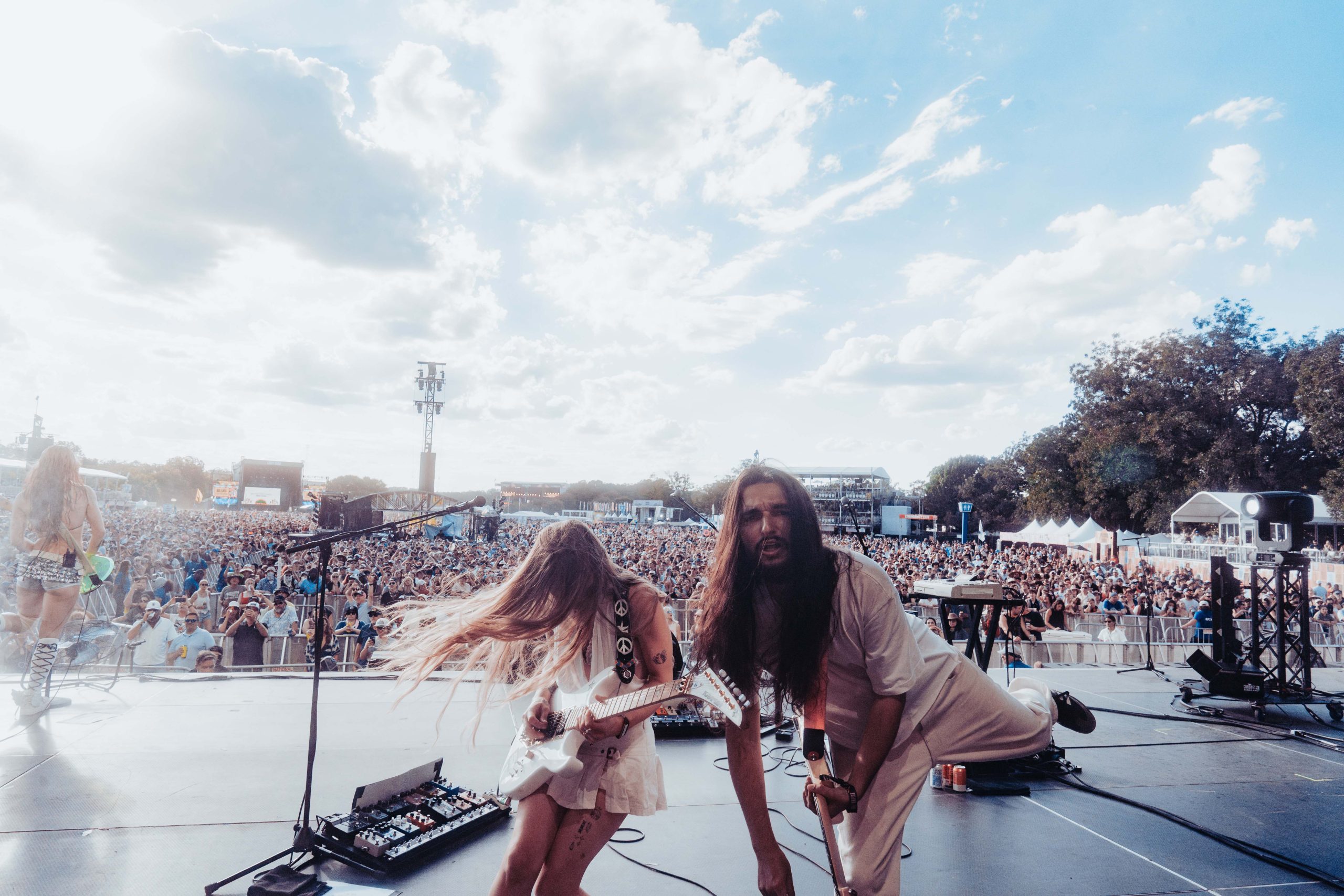


In recent years, few bands have made a leap from the UK underground to the upper reaches of the international circuit like Wet Leg. Formed on the Isle of Wight off the south coast of England in 2019, the indie rockers soon outgrew their island roots. Propelled by 2021’s viral hit “Chaise Longue”—co-written by Joshua Mobaraki with founding members Rhian Teasdale and Hester Chambers—Wet Leg released their acclaimed self-titled debut album the following year. Relentless touring ensued, and the five-piece evolved in real time before huge crowds. 2025’s moisturizer LP captured that transformation: tougher, brasher, and more instinctive, it’s the sound of a band that’s fully hit its stride.
Level Up
Wet Leg came out swinging and picked up a Grammy for Best Alternative Music Album in 2023, while “Chaise Longue” scored the win for Best Alternative Music Performance. This year, at the 68th Annual Grammy Awards, moisturizer and “mangetout” were nominated in the same categories, respectively.
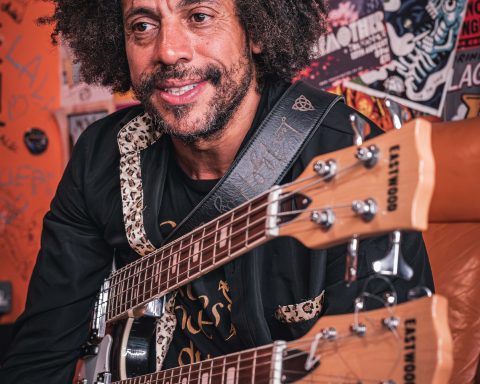
Joshua Mobaraki’s role in bringing those works to life cannot be overstated. As a key writing member and performer, he occupies a space at the heart of Wet Leg’s expansive sound.
BOSS has been part of Mobaraki’s story from the beginning. In fact, his very first effects pedal was the DS-1 Distortion, and this iconic orange stompbox still sits in his collection today.
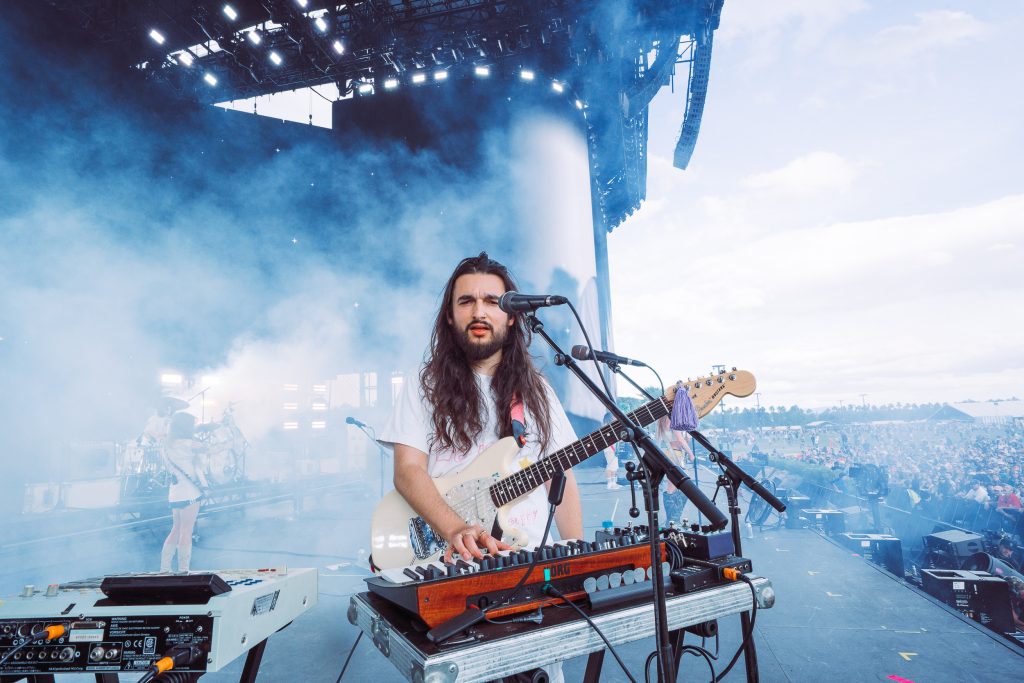
His current live setup is built around a carefully dialed-in BOSS rig. The WAZA Tube Amp Expander Core keeps his amp at its sweet spot without overwhelming the stage, while the ES-8 Effects Switching System conveniently handles signal routing. Up front, the TU-3 Chromatic Tuner does exactly what it should—clear, fast, and fuss-free.
The Big Picture
You’ve been making great use of the BOSS WAZA Tube Amp Expander Core in your rig. Tell us about that.
I use the Tube Amp Expander Core live because I can’t crank the amp loud enough without it. In a traditional rock band where the singer is half shouting into an SM58, you can often turn amps up, and it’s usually fine. But in Wet Leg, there are a lot of vocal mics on stage.
I play next to my partner, Hester [Chambers, guitarist], who sings pretty quietly. If I have my amp blaring, it messes with the mix. I’m not one of those guys who’s like, “But my tone won’t be right if the speaker isn’t driving blah blah.” The overall picture is the most important thing—the whole mix.
Did you try using a smaller amp?
To begin with, I went with a smaller combo—a [Fender] ’68 Princeton Reverb reissue. But even then, I couldn’t crank it loud enough. It was chill on a bigger stage, but I couldn’t turn it up loud enough to break up when we were doing TV stuff or recorded sessions in small rooms. It was always a problem.
"I use the Tube Amp Expander Core live because I can’t crank the amp loud enough without it."
Drive Forward
How did you work around that initially?
Originally, I was using compression and drive pedals to recreate the sound of the amp being compressed and driven at higher volume. But I decided to get the BOSS Tube Amp Expander Core so I could drive the Princeton Reverb naturally at lower sound levels.
Recently, I came across a 1960s black-panel [Fender] Bassman head and cab piggyback for a good price in Austin, Texas. The ‘60s Bassman and the Tube Amp Expander Core are really working for me now. It’s not a problem at all anymore.
How does the BOSS WAZA Tube Amp Expander Core fit into your rig now?
The Tube Amp Expander Core sits between the Bassman head and cab. Front of house was using its DI [line out connections] with cab emulation, and there was a mic on the cab for my in-ears, but we use the cab mic for everything now. The cab emulation sounded great, though.
High Headroom
What does your gain staging look like?
My amp is set so it’s compressing a lot and just on the edge of breakup, then I step on a clean boost for my overdrive sound.
The second layer is a heavy sound, using a pedal that emulates a Neve console being blasted. I’ve always been interested in unconventional distortion sounds, and prefer when they don’t force me to change the way I play too much.
The third layer is a Tone Bender-style [fuzz] pedal, but that goes straight out via a DI from my BOSS ES-8 and doesn’t hit my amplifier at all.
"My amp is set so it’s compressing a lot and just on the edge of breakup."
DI-ing a fuzz to front of house is an interesting approach. What do you like about that sound?
Guitar speakers and amps roll off a fair bit of the top end of a fuzz sound, and there is something really cool and synthesizer-like about those frequencies. It’s an interesting place to explore. It’s a bit of a shoegaze thing.
The cool thing about using a gain pedal that doesn’t go into an amp is that you don’t affect the amp’s headroom. So when you’re using multiple distortions, it’s like another layer again.
Stacking more gain pedals into an amp, you’ll eventually run out of headroom, and the sound actually becomes less aggressive; it starts to sound softer and spongier.
Switch It Up
How do you have your BOSS ES-8 Effects Switching System set up?
The Tone Bender-style fuzz tone comes straight out of my ES-8, in parallel with my main guitar sound. Each footswitch on my ES-8 corresponds to a pedal on my board, and I keep that consistent across all songs. It’s also handy because if one of the pedals fails, it doesn’t take everything else in the chain down with it.
I have the ES-8 set up so that each song starts with all the correct pedals engaged; there’s a patch for each one, so I don’t need to reset anything. The ES-8 also sends MIDI to the keyboard to select the correct patch. Essentially, the ES-8 makes sure that all the right pedals and sounds (and none of the wrong ones) are ready and waiting at the start of each song.
From then on, I use the ES-8 manually, just like a normal pedalboard, switching individual pedals on or off at the right points. That way, I can also try something a bit different on the fly if I want to.
"Each footswitch on my ES-8 corresponds to a pedal on my board... I have the ES-8 set up so that each song starts with all the correct pedals engaged."
BOSS First
You also use the BOSS TU-3 Chromatic Tuner. What do you like about that pedal?
The BOSS TU-3 Chromatic Tuner is kind of the best tuner out there. I love that the LEDs tell you when you’re locked in, because you don’t have to make a judgment call. It’s just super clear when your guitar’s in tune. Like, “It’s done. It’s in tune. It’s all good.”
Can you recall your first BOSS pedal?
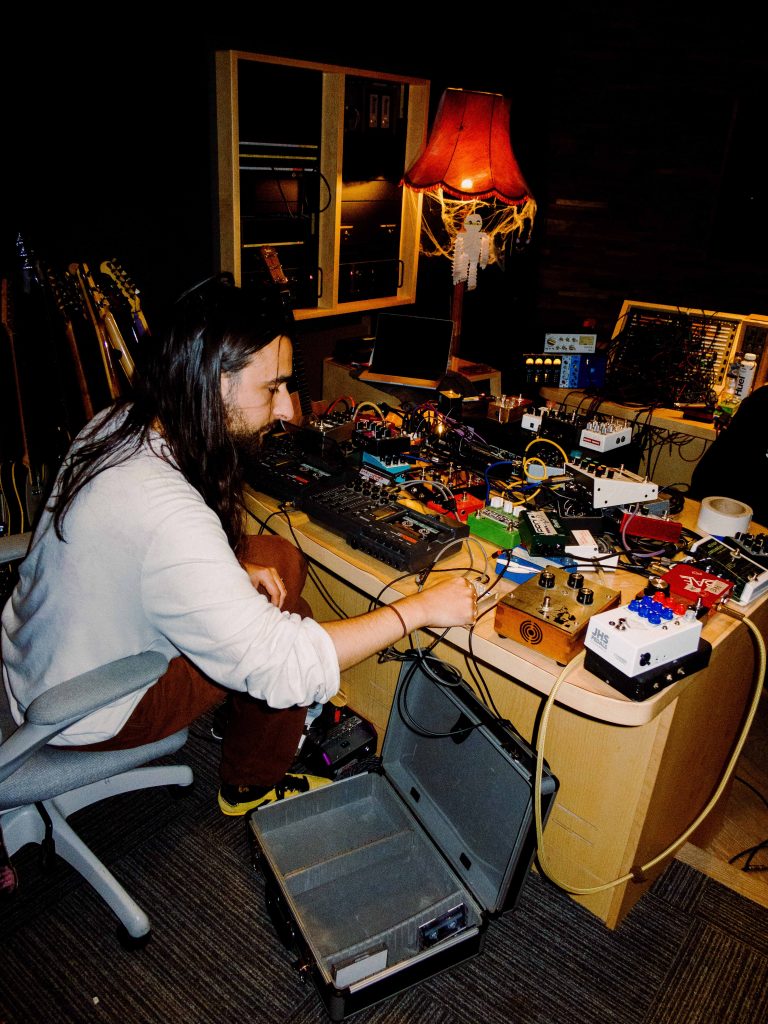
My first guitar pedal was a BOSS DS-1 Distortion (like virtually every other guitarist I know). That’s such a classic. I’ve still got it. My auntie bought it for me for my birthday one year before I even knew what a guitar pedal was. I was like, “What is that?”
When I was about 15, I did a mod and chopped out one of the components. When I was a kid, I was like, “I want to build pedals and guitars.” I wanted to do all this stuff, but, looking back, I was kind of getting distracted from just making music.
Timeless Sounds
What are some of your favorite BOSS gain pedals?
I know the BOSS BD-2 Blues Driver has been around for a really long time now, but I think it doesn’t get enough love. I haven’t used it in a little while, but I remember thinking it sounded great the last time I plugged into it.
The BOSS HM-2 Heavy Metal is another cool gain pedal. It’s famous for that quintessential Swedish Death Metal sound—it just sounds mad.
Which BOSS delay pedals do you really like?
I really like the OG Space Echo units and the DM-2 Delay, but I also love BOSS Digital Delays. The DD-7 Digital Delay was a big deal when I was growing up. I’m thinking about getting a BOSS Digital Delay now for that super-clean digital delay sound.
I’ve basically become the reverse of what I was as a teenager. When I was younger, I was into ambient, spacey sounds and harmonized shimmer reverbs, but now I want the complete opposite. These days, I’m much more interested in delays that are like clear, crisp samples and stutters.
"The BOSS TU-3 Chromatic Tuner is kind of the best tuner out there."
Major Delays
When did you last hear a BOSS Digital Delay in action?
I saw Geese recently, and they were incredible. Emily [Green], the guitarist, was using a BOSS [DD-5] Digital Delay for that machine gun sound—like super-fast resampling. It sounded so cool. The top end doesn’t roll off in the delays; it’s not about warm repeats. If I wanted to make that kind of sound, I’d look at BOSS Digital Delays, for sure.
Ed O’Brien also gets some cool sounds from the DD-5. Some of the more extreme settings of BOSS Digital Delays are worth experimenting with.
Yeah, the extreme Digital Delay settings are what I’m more into now. With very short delay times, where the echo almost starts to take on a note—that sort of ring modulation or FM vibe [frequency modulation].
BOSS covers the entire delay spectrum, from the mechanical, warm tape delay of Space Echo, with all the artifacts we love, to clean, pristine Digital Delay. I love that it’s accessible to everyone, whether you’re playing in your bedroom or an arena.
BOSS pedals like the RE-202 and RE-2 Space Echo, and the SDE-3 Dual Digital Delay, certainly make it easy to recreate classic studio sounds live.
Original vintage gear from the ‘70s, ‘80s, or whenever is really cool to record with, but live, I need it to work every night. That’s not to say there isn’t a place for using things like the old Space Echo units live—they’re rad. But obviously, a lot of it is delicate, which can be a real headache. And then, you know, you turn up to play at the festival, and it’s a windy day, and now your whole mix is being blown around a field anyway.
Bottom-End Spread
Which vintage BOSS pedals do you like?
I love the CE-1 [Chorus Ensemble]. It almost looks military, like it’s from World War I or something. I got to use it when we recorded Wet Leg’s second album, moisturizer, and, yeah, it was sick.
Ellis [Durand], our bass player, also used the CE-1. He’s into baritone and [Fender] VI basses and likes layering them with regular bass. He’s into synth bass as well. Not loads of it, but he just loves 100 Hertz and down, you know.
"I got to use the CE-1 Chorus Ensemble when we recorded Wet Leg's second album, moisturizer, and, yeah, it was sick."
How did you navigate balancing different bass instruments in the mix?
The challenge is that once your main bass is sitting in the center of the mix, layering additional low-end instruments like Bass VI or baritone guitars can make things sound muddy. So, we used the CE-1 with a slow rate and a high mix to spread it across the stereo field and carve out space for the main bass sound.
It feels bigger and richer without losing clarity or low-end focus. I’m always using stereo imaging tricks like that when recording or making beats.
Are there any other BOSS pedals you’ve used for similar studio tricks?
I also like using the BOSS DC-2 Dimension C to enhance the stereo image. I love that it’s just buttons and no knobs. It’s fun to have different options for the same job, trying out different colors for the same patch.
When it comes to the stereo image, I really like it to be either very asymmetrical or very symmetrical. And a tool like the Dimension C lets you get things out of the center symmetrically.
I also like stereo tremolo panning, which is another way to get things out of the center without causing the overall mix to lean too far left or right. That works really well sometimes.
"BOSS and Roland have invented instruments and effects that defined entire categories of gear, like characters of music history in their own right."
Making History
What do you like about BOSS pedals generally?
BOSS and Roland are such iconic brands and have invented instruments and effects that defined entire categories of gear, like characters of music history in their own right. It’s easy to forget how much stuff BOSS and Roland have given the music world.
Josh Scott from JHS is a prolific pedal collector, and he says his favorite pedal company is BOSS. Some people are like, “What about the boutique stuff?” But he’s almost like the opposite of that mentality. It’s interesting.
From drum machines to guitar pedals, Roland and BOSS gear have defined the sound of certain musical genres.
Yeah, like the augmented [TR-]808 sounds of trap music. We were in Japan recently, and I found a place with a bunch of music stores in one building. On the top floor, there were loads of electronic instruments plugged in, which was fun. I was drawn to a drum machine they had.
I’ve never had a proper drum machine, so I was thinking about that. When I got back, I started doing some research, and it seems the Roland TR-1000 [Rhythm Creator] is the way to go right now.
"I started doing some research, and it seems the Roland TR-1000 [Rhythm Creator] is the way to go right now."
Beat the System
The TR-1000 is perfect for authentic analog 808 and 909 sounds, and the workflow is straightforward.
It’s not just the sounds of the equipment that influenced how people made certain styles of music; the workflows are important, too. The way a step sequencer works has a major impact on how you write a line. A sampler and 16 pads will have you writing something entirely different.
When I was a kid, I had no idea. I was always asking, “How do I make beats like I hear in my favorite rappers’ songs?” I didn’t even know what sampling was. I didn’t know the tracks I heard were other songs being chopped up and rearranged. The first time I heard a vocal chop, I was like, “What is going on?” Those sounds basically exist because of the equipment itself.
Live Take
Making gear straightforward to use is so important, whether on stage or in the studio.
Yeah! Nobody seems to talk about it much, but performing live and performing in the studio are very different things—at least for me. There are some basics I need from the equipment I use live that often get overlooked. Visual feedback is very important, for example. But at the same time, I don’t want it to feel like I’m looking at a computer.
Also, being able to save and recall patches easily is super important. When I see people on stage with something like an MS-20, it looks fun, but I’ve no idea how they use it live for more than, like, one sound for one song. Patch cabling is the last thing I want to deal with when I’m performing on stage. I know it sounds basic, but those fundamental things are important to me.
I think some of this stuff is fun for the studio, but even in the studio, it’s only really fun if you’re on your own. I mean, you don’t normally have the luxury of exploring a sound for an hour when you’re in the studio with a group of people. If you’ve got the rest of the band in with a producer and you just need to get an arpeggiator line down, it’s really not a good idea to slow the session down because you want to try every wavetable out.
"The whole point is to make music... I think it’s good to keep your eye on the ball and not get too distracted."
Flow State
What do you think the most important thing is when it comes to gear?
Really, the most important thing is being able to get a sound you’re excited by as quickly as possible, without just scrolling through presets. I always want to reach a flow state where one good thing follows another—ideas falling like dominoes.
That’s a great feeling. As opposed to like, “Now it’s gonna take me half an hour to get this sound just right.” Or, “I want to explore the next thing, but I can’t because we will lose the sound that we’ve made to begin with if we do try something else.”
The whole point is to make music. If you do see yourself more as someone who just likes playing with gear, that’s totally cool, and there’s nothing wrong with that. But if you’re like me, I think it’s good to keep your eye on the ball and not get too distracted.