

Over the past two decades, Emma Ruth Rundle has forged a singular path through modern alternative music. Renowned for her emotionally charged songwriting and richly textured musicality, she has built a body of work that shifts seamlessly from towering intensity to tender introspection.
The Eclectic Guitarist
From her early work with The Nocturnes, Red Sparowes, and Marriages to a celebrated solo catalog, collaborations with the likes of Chelsea Wolfe and Thou, and a published collection of poetry titled The Bella Vista, Emma Ruth Rundle’s work has consistently defied easy categorization.
That winding journey reaches another turning point with her latest album, These Killing Times. In stark contrast to 2021’s Engine of Hell, it was written with a full band in mind from the outset, and tackles the contemporary weights of the world without surrendering to despair—exchanging isolation for collaboration and finding hope in shared experience. Those ideas run throughout the conversation that follows, as Rundle reflects on the experiences that shaped her creative identity, the philosophy behind her songwriting, and the BOSS and Roland gear that have remained constant ingredients in her unique brand of sonic alchemy.
Accessing Other Worlds
What first drew you to creating music rather than simply learning an instrument?
I think it was the very physical, transportive experience of hearing music. You hear something that takes you somewhere else, and suddenly you want to pick up an instrument because you want to access that space yourself. For me, it was hearing an Alan Stivell record as a child. It was a Celtic harp album, and it completely transported me into another world.
I started learning the harp because I wanted to be in that place, and although I eventually moved to guitar, that feeling never changed. I never really had formal lessons or a traditional teacher-student relationship. My whole approach was driven by curiosity, little mentors along the way, and countless hours figuring things out for myself. Looking back, I think that made learning an instrument a creative process in itself, because it was always led by the music that fascinated me rather than a repertoire someone else chose for me.
What did teaching yourself allow you to discover that a more traditional musical education might not have?
I never reached a point where I had to break away from someone else’s idea of what I should be playing. Everything I learned came from curiosity and the music that fascinated me. I’d sit for hours trying to pick out the notes to a riff or solo, just exploring and figuring things out for myself. Looking back, that meant discovering the instrument and discovering my own creative voice happened at the same time. Learning never felt separate from creating because the whole process was driven by whatever had captured my imagination in that moment.
Which musicians first made you see the guitar as a creative instrument?
Some of my earliest guitar memories are of sitting with Siamese Dream by The Smashing Pumpkins and trying to work out what was happening. I still think it’s an iconic guitar record, not just because of the tones but because of the playing itself. As I’ve grown older, it’s been fascinating to hear the influences within those records too. There’s so much Jimi Hendrix in Billy Corgan’s playing, and Hendrix was another huge influence on me. My dad had his records, and I’d sit in front of the record player listening with my dad and stepmom. Those records became part of the musical world I was growing up in.
Further Down the Rabbit Hole
Your use of alternate tunings has become a defining characteristic of your guitar playing. Looking back, do you think those early Celtic influences helped guide you towards that?
I think there is a link. On some subconscious level, I was absorbing and resonating with that Celtic harp music when I was so little. I longed for that sound and the modality of that music, but I never really connected it to the guitar until much later. When I was working at McCabe’s Guitar Shop, I discovered that so much Celtic guitar playing is in DADGAD tuning, and that’s when it all started to make sense. Looking back now, it probably did shape the way I approached the instrument from the very beginning. I’d never really put that together before, but yeah, I think that’s probably true.
"I had ambitions of becoming a more traditional virtuoso, but at some point I let go of that idea and disappeared further down the rabbit hole of my own little world."
Was developing your own style something you consciously pursued?
I think it’s probably a product of the diverse influences I’ve had and the way I learned. Working at McCabe’s gave me the opportunity to absorb so much from so many different kinds of guitar players. There were classical players, bossa nova players, fingerstyle players—people would just call me over and show me something new, give me tabs, or demonstrate a technique. If the shop was quiet for a few hours, I’d spend that time practicing whatever they’d shown me.
At the same time, open tunings just made sense to me. I actually think they’re easier to play in because the root and the fifth are immediately available, and you can reduce almost any song to its simplest form. When I was younger, I had ambitions of becoming a more traditional virtuoso and learning a style that would let me work in lots of different genres. At some point, though, I let go of that idea and just kept disappearing further down the rabbit hole of my own little world of playing.
Who We Are as Animals
Has music always felt like a form of expression to you?
Yeah, expression through an instrument was instantaneous for me. Even as a kid, there was something incredibly powerful about being able to create a sound. In other parts of my life, maybe I didn’t feel like I had much of a voice, but I could make music. I think music is so inbuilt—not just culturally, but as part of who we are as animals. It’s part of our ancient experience. I had a very early, positive feeling that I could express myself through an instrument, and then through my voice. I could make something that felt beautiful, and I think that’s still the idea.
If your younger self could see where you are today, what do you think would surprise her most?
I think everything about it would be surprising. My musical tastes are still very much in harmony with that younger version of me, but I think she’d be amazed by my facility on the instrument. Looking back now, I recognize that what I can do is probably pretty basic, but when you’re young, that sense of awe is so abundant. You see somebody draw, or play an instrument, or create something beautiful, and you think, “How did you do that?” I think that’s how my younger self would feel now. She’d be impressed that I could do the things I once thought were impossible.
"The new album has a much more activated, angry energy. It's more about getting to a place of action."
These Killing Times
Why did These Killing Times need to occupy such a different space from [previous album] Engine of Hell?
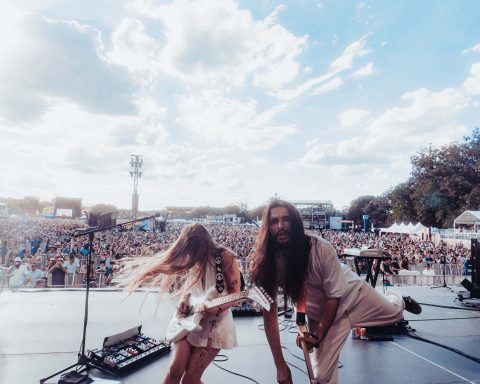
There was a conscious decision to write for a band. I knew from the beginning that this was going to be a more produced, fleshed-out record, calling back to some of my earlier albums. A big part of that was simply missing the experience of playing with a band. I hadn’t done it since 2019, and while making Engine of Hell and touring it solo was exactly what I needed at that point in my life, after five years I really missed the power, the volume, and the camaraderie of being on stage with other people.
That naturally shaped the emotional world of the record, too. Engine of Hell was me trying to make the most depressing album I could. This one has a much more activated, angry energy. It’s less about lying down on the train tracks and more about getting to a place of action.
Hope feels central to this record. Was that something you consciously wanted to convey?
Yes, absolutely. I’m really happy to hear you describe it as hopeful because I didn’t want to make a doomer album about everything that’s happening in the world. Whatever ending you imagine, we need hope. It’s crucial, because it’s the thing that keeps us out of despair. Making a record with a band also became part of that thinking. If we’re going to get through this, it’s got to be together. I wanted to create something that made me feel connected to a community, and I hope that through making this album and taking it on the road, it can help bring some of that into the real world.
Which song changed the most between the first demo and the finished record?
I tend to demo my songs in a fairly sparse way. It’s usually just acoustic guitar, maybe some piano, and then I have an idea of where the dynamics will go. We always leave room in the studio for things to evolve, though, and a lot of this record grew through those additional layers. “Human Kindness” probably changed the most. Earlier versions had different backing vocals and a different melody. My original vision was a little eerier—there was a kind of mystique to it that I kept trying to hold onto—but that’s the nature of the studio. Songs evolve as different ideas come in.
"There are some classical guitar parts on the album that were completely improvised in the studio. I love things that happen off-the-cuff."
Is there a particular moment on the album that you’re especially proud of?
The first thing that comes to mind is actually Nick Reinhart’s part on “Human Kindness”. Every time I hear it, I’m so excited, even though it’s not my playing. Beyond that, there are some little classical guitar parts that were completely improvised in the studio. There’s a small bridge in that same song that we jokingly called “Into the Shire,” and I just made it up on the spot. I love things that happen quite randomly or off-the-cuff in an improvised manner.
The Right Gear for the Grind
Do songs begin with a sound in your head, or does the tone reveal itself later?
The ideas always come first. I demo everything on acoustic guitar, so I’m really just thinking about the song at that stage. I do have a standard effects chain that’s become my comfort palette, and there are certain sounds that are absolutely integral to what I do, but I’m always open to discovery once I get into the studio. There were days on These Killing Times where we’d sit with a bunch of different overdrive pedals, trying to find exactly the right character for a part. Unless I have a very strong idea already, I’m happy to go on that journey. I start with the basic palette of what I think of as the “Emma” sound, then leave room for the songs to evolve through that spontaneous creative process.
BOSS pedals have become such a defining part of your sound. How did they earn that place?
The first pedal I ever bought was the DD-5. Like every young guitarist, there comes a point where you discover what delay is, or realize that reverb is like putting a church into a pedal. The DD-5 had a reverse delay mode, and I could spend hours with it, creating those sounds that you just want to get inside of. I’ve had a DD-5 or DD-6 on my pedalboard ever since, usually set quite subtly so it creates a kind of blurring effect around the notes before running into a reverb.
The RV-5 was the next one that really stuck with me. When I was getting into shoegaze, the Modulate mode was everything—that watery, almost chorus-like quality became a huge part of my sound.
Beyond the sounds themselves, I’ve always loved BOSS pedals. Maybe it’s because they were my first, but to me they’re simply what a pedal should look and feel like. They’re intuitive, they’re incredibly durable, and after fifteen years of touring with the same pedals, they’ve never let me down. I recently had a friend who was new to guitar ask me what to buy, and they’re really easy to recommend because, to me, they represent the quintessential version of those effects.
"The Roland JC-120 is the core of my sound. I want to be buried with this amp."
The JC-120 has become almost inseparable from your sound. What is it about that amplifier that has kept it at the heart of your rig?
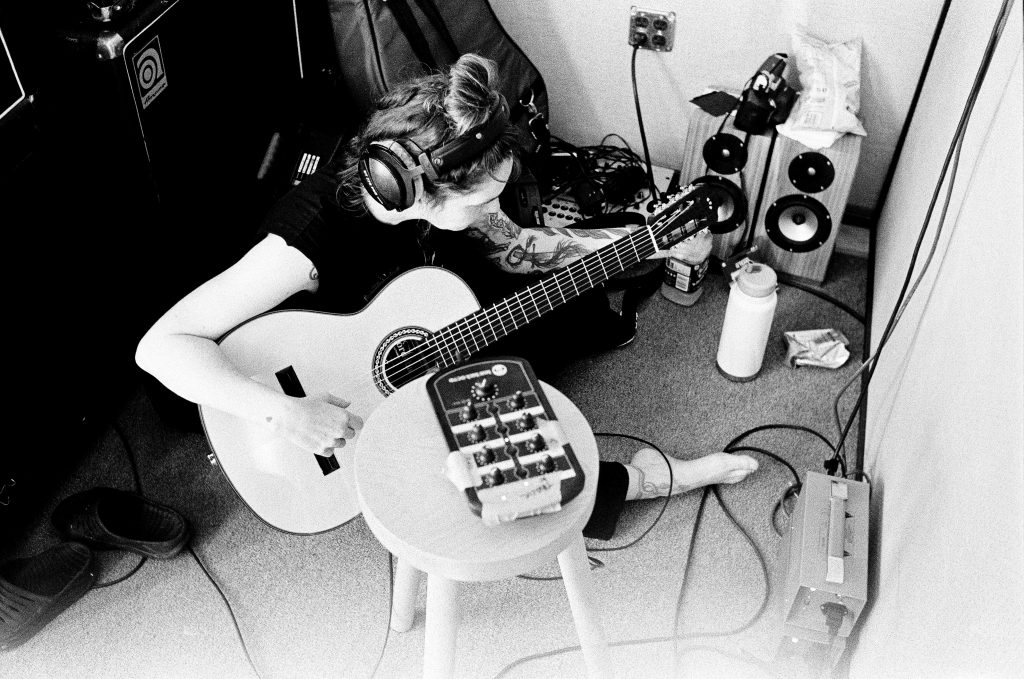
I honestly can’t remember exactly how the Jazz Chorus first came into my life because it’s been with me for so long now. Before that, my dad had a pair of solid state amps, and I became really attached to the clarity and transparency. At some point, someone suggested I try a Jazz Chorus, and from then on it just became my foundation. I don’t really know what I sound like without it. My tube combo is there to add color, but the JC-120 is the core of my sound. Every record I’ve made over the last several years has featured that amp, and I even brought it with me to Los Angeles to record These Killing Times. I want to be buried with this amp.
Piecing the Puzzle Together
Has your definition of a good song changed over the years?
Probably not. I don’t think it has anything to do with genre, aesthetics, or even a particular sound. For me, a good song is something that’s authentic and true, something that produces a genuine reaction in me or in the listener. Not every song has to be a great song, though. Some songs just need to exist. I have a handful that I think of as great songs, others that are a little clunky, and some that are just fine. And that’s okay.
How do you know when a song idea is worth pursuing?
It’s both instinct and experience. The thing that makes you want to keep writing is that feeling of curiosity. If you’ve found something that makes you want to stay up until five in the morning, just because you need to keep putting the puzzle pieces together, then it’s worth following. Even if it’s difficult, that kind of excitement tells you there’s something there.
But you also have to be honest with yourself. Is it difficult because all songwriting is difficult, or is it simply exhausting and not going anywhere? I spent almost a year trying to finish one song for this record because I loved its mystique and the existential world it was exploring, but I could never sculpt it into the shape it needed to become. At some point, deadlines become helpful. They force you to recognize when it’s time to walk away.
"I think it's important to engage with your craft outside your normal wheelhouse. It helps you maintain that childlike sense of curiosity and wonder."
Maintaining Curiosity
What still excites you creatively about the songwriting process?
I think you reach a point where your musical identity is established. I’m not searching for who I am as a songwriter anymore or trying to define my tonal palette—I feel like those things are well formed now. The freshness comes from a different place. It’s about relaxing a little, accepting that this is the path I’m on, and not feeling the need to control every outcome.
On These Killing Times, so much of that excitement came from collaboration and trusting the people I’d invited into the process. When you open yourself up to writing, you never know what will come through. There were plenty of songs that ended up in the trash, but over time you develop the confidence to know when to let go and when to keep going. That’s the part that still feels exciting to me.
You’ve developed such a distinctive musical identity. Is there still somewhere creatively you’d like to go?
Yeah, definitely. I actually went down a trance rabbit hole last night, and I’d really like to make electronic music again, even if it’s just for my own enjoyment. Not necessarily as the Emma Ruth Rundle project, but because I think it’s important to engage with your craft outside your normal wheelhouse. Even if it has no commercial purpose, it helps you maintain that childlike sense of curiosity and wonder.
I took classical guitar lessons for the same reason. It kept my brain interested in the instrument, and then that energy came back into everything else I was doing. Those little side quests are really valuable. I used to make electronic music—the first band I ever played shows with was much more electronic—and I think it would be fun to return to that.
"If there's a little girl out there who wants to rock, I hope she can see me and know that's absolutely something she can do."
If a young musician discovered These Killing Times and decided to pick up a guitar, what would you hope they took away from your music?
I hope they’d realize that, at their core, these songs are actually very accessible. There’s nothing especially esoteric about what’s going on—you just have to get into the right tuning and spend time with them. More than anything, though, I’d hope they find community. Play music with other people. Start a band. Be engaged socially and globally, connect with the people around you, and don’t give up. Playing music isn’t always easy, but it should be fun, at least some of the time.
When I was growing up, there wasn’t much representation for women in guitar music. Things have changed a lot since then, and that makes me really happy. If there’s a little girl out there who wants to rock, I hope she can see me and know that’s absolutely something she can do.