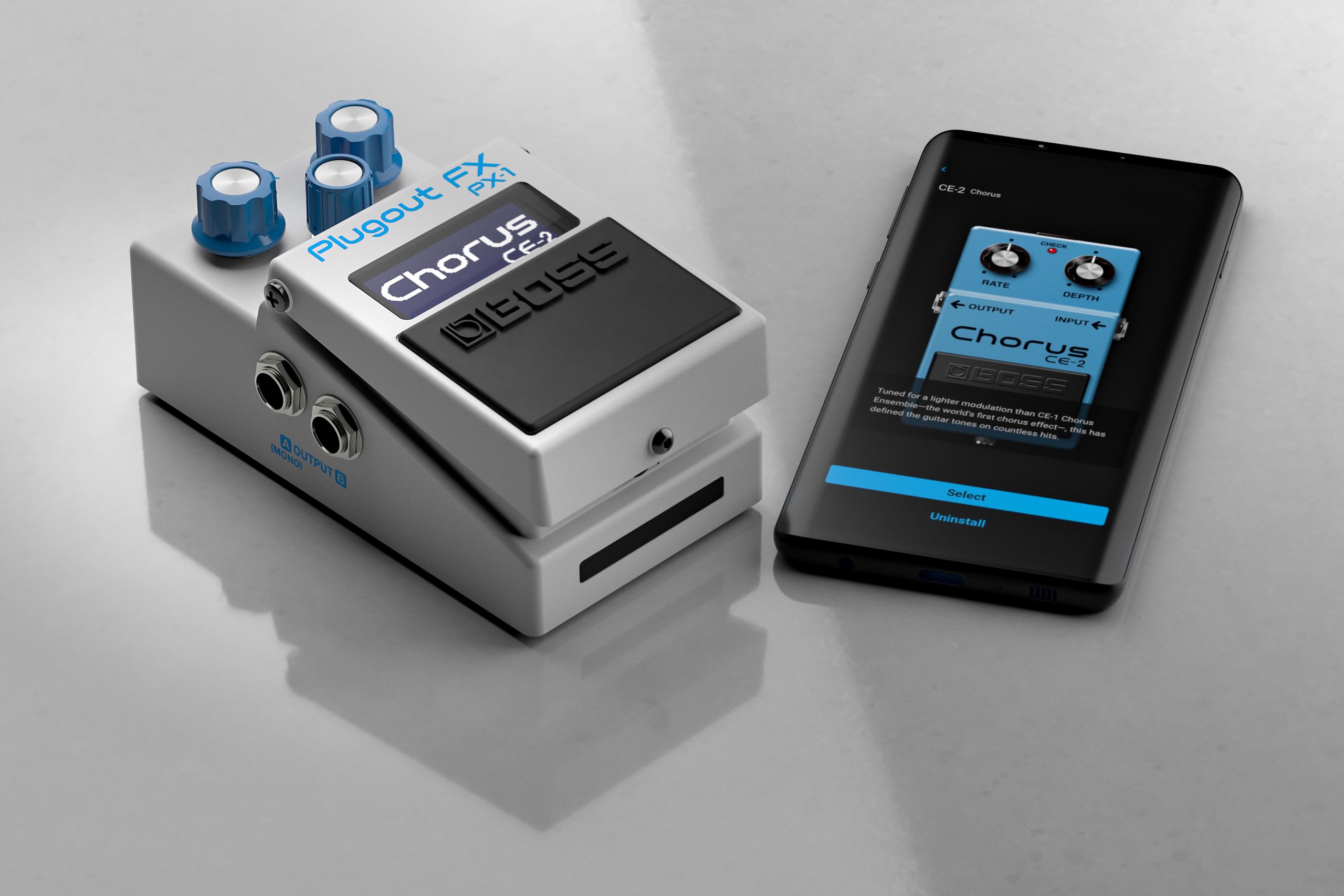
The PX-1 Plugout FX compact pedal gives guitarists of all styles and levels access to a spectacular array of vintage, rare, and classic BOSS effects. Curated from a historic catalog of game-changing devices, these timeless sounds are meticulously crafted using original units and brought to life with stunning realism. Our team of engineers in Japan is working tirelessly to expand the PX-1’s range of authentic BOSS effect models, and optional Model Passes are being developed continually. Keep an eye out for new PX-1 releases as they appear on the BOSS website and PX-1 app. In this article, you can read all about the first trio of PX-1 Model Passes released in January 2026, comprising the DM-2 Delay, DC-2 Dimension C, and OD-2 TURBO OverDrive.
Out of the box, the PX-1 comes with eight “1” designation BOSS effects baked into its permanent library, so you can start playing immediately. These include the 1977 debut “traffic light” trio of compacts—the OD-1 Over Drive, PH-1 Phaser, and SP-1 Spectrum—along with the DS-1 Distortion, CS-1 Compression Sustainer, TW-1 T Wah, SG-1 Slow Gear, and SD-1 SUPER OverDrive.
Beyond this, the PX-1 boasts eight user locations for storing your preferred choice of effects. Simply register your PX-1 with a free Roland Account and download the CE-2 Chorus, BF-2 Flanger, OC-2 Octave, VB-2 Vibrato, DD-2 Digital Delay, DF-2 SUPER Feedbacker & Distortion, PS-2 Digital Pitch Shifter/Delay, and PN-2 Tremolo/Pan using the BOSS Effect Loader app.
You can read all about the origins of these 16 awesome BOSS effects included in the PX-1 Plugout FX package here.
Expanding your collection is easy. With the option to purchase PX-1 Model Passes as they are released, you can curate your own BOSS effects library over time. That way, you’ll enjoy the sounds of vintage, rare, and classic BOSS stompboxes without paying collectors’ prices.
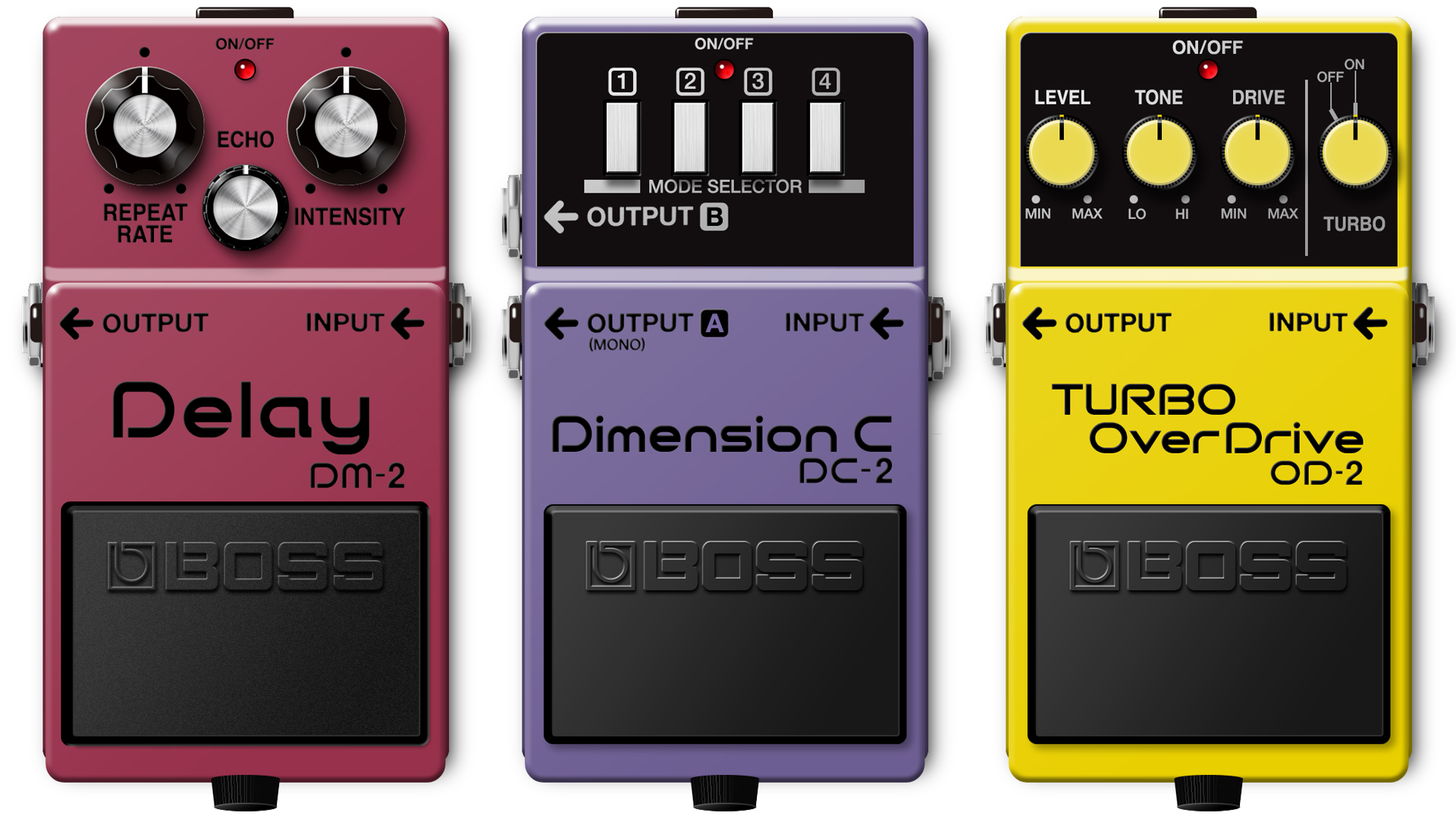
So far, two batches of PX-1 Model Passes have been released. You can read all you need to know about the pedals featured in the first one, released in January 2026—the DM-2 Delay, DC-2 Dimension C, and OD-2 TURBO OverDrive—below.
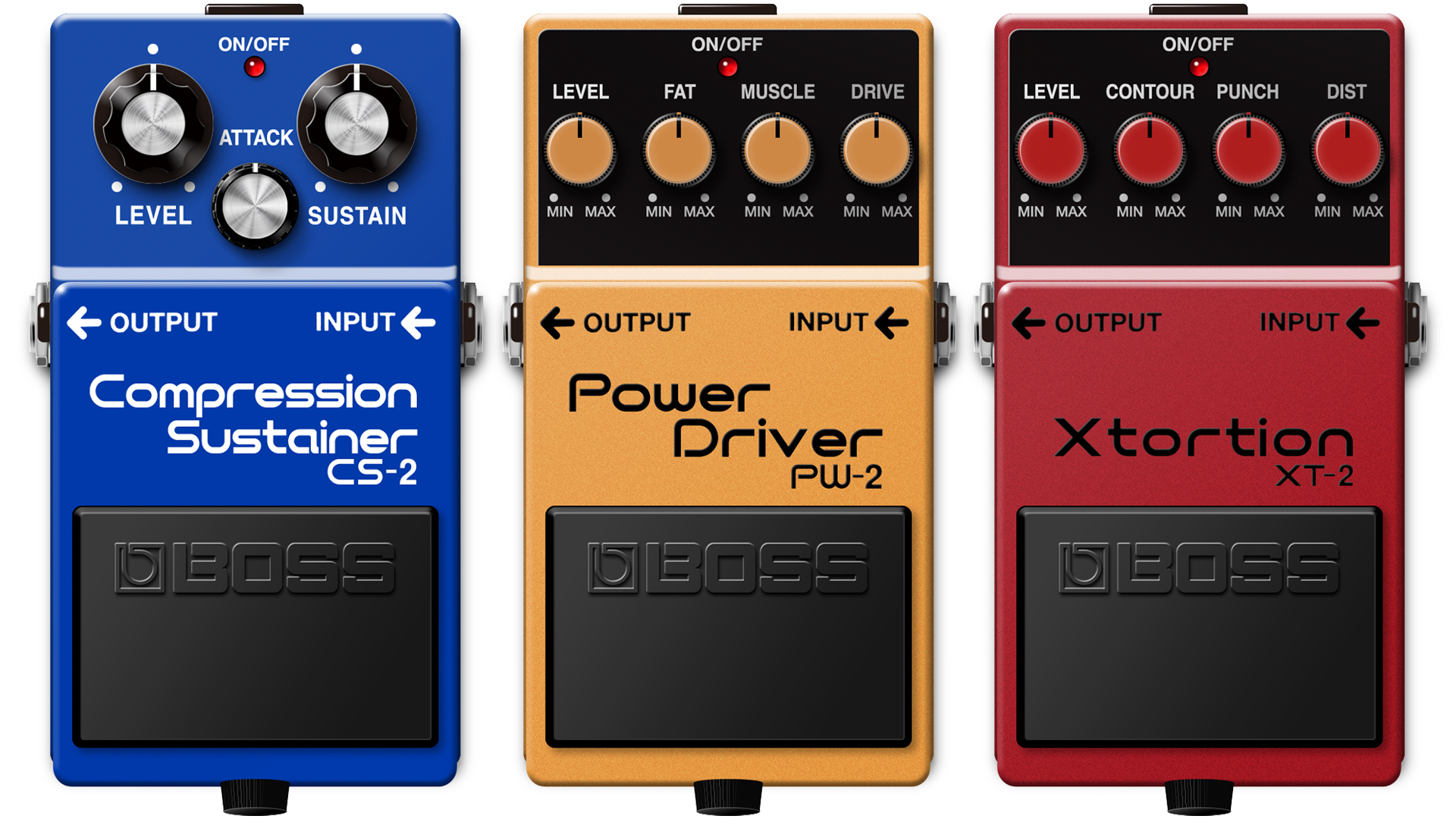
If you would like to learn more about the pedals featured in the second batch of PX-1 Model Passes, released in May 2026—the CS-2 Compression Sustainer, PW-2 Power Driver, and XT-2 Xtortion—then click here.
DM-2 Delay
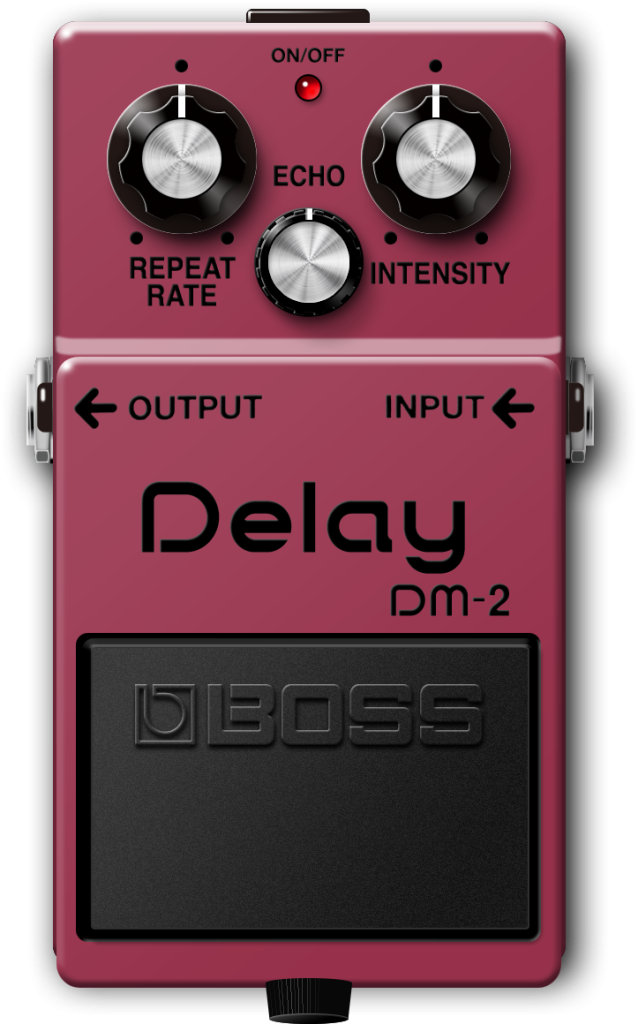
Released in 1981 and remaining in production until 1984, the DM-2 Delay was the first BOSS compact analog delay pedal and remains a timeless classic. Its straightforward three-knob layout—Repeat Rate, Intensity, and Echo—offered quick, easy control over delay time, feedback, and volume (respectively).
Artfully combining simplicity and sonic flexibility, the DM-2’s appeal endured ceaselessly after discontinuation. From subtle tape-like slapback to reverb-y washes and feedback-driven psychedelic effects, it yielded soft, musical repeats that sit naturally in a mix.
At its core, the DM-2 used BBDs (MN3005 and MN3101) to generate delay, with a 20–300ms range set by the Repeat Rate. Its all-analog design ensured warm, smooth echoes that were easy on the ear, making it a versatile tool for virtually any playing style.
As delay time increases, frequency characteristics shift and noise subtly rises, adding depth and character to the sound. Analog companding—a combination of compressor and expander circuitry—softens attack while reducing noise, resulting in a wonderfully balanced tone.
Pro tip: A lesser-known feature of the DM-2 is that it can be used for a tone-thickening boost by setting Repeat Rate and Echo fully clockwise, and Intensity fully counterclockwise.
DC-2 Dimension C
The BOSS DC-2 Dimension C, produced between 1985 and 1989, was derived from the Roland SDD-320 Dimension D rack unit introduced in 1979. Renowned for its clear, unobtrusive spatial enhancement, the 2U, 19-inch SDD-320 rapidly became a studio staple and can be heard on countless recordings.
Favored by a legion of artists ranging from Stevie Ray Vaughan to The Prodigy, the SDD-320 featured balanced XLR and unbalanced quarter-inch connections, with switchable mono or stereo inputs and an output design geared toward stereo applications.
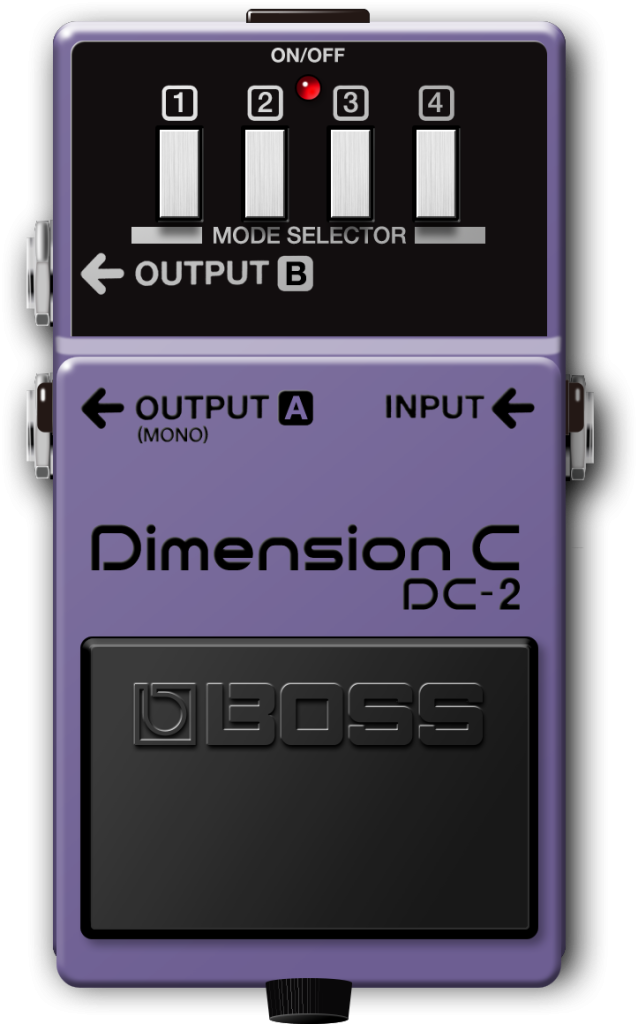
The DC-2 distilled the revered Dimension sound of the SDD-320 into a compact pedal, offering pro-grade sonics in a format tailored for guitar rigs. With a single input and mono or stereo output options, the DC-2 delivered focused yet expansive tones. It enriched instrument signals with depth, articulation, and presence—even in mono—while remaining remarkably faithful to the SDD-320 in stereo operation.
Controls were minimal yet effective: four slender buttons selected distinct presets, each providing clarity and dimensionality without the pronounced pitch modulation associated with many choruses. This winning combination of elegant simplicity, superlative sound, and refined analog processing (including a noise-reduction circuit) cemented the DC-2’s status as a bona fide classic.
OD-2 TURBO OverDrive
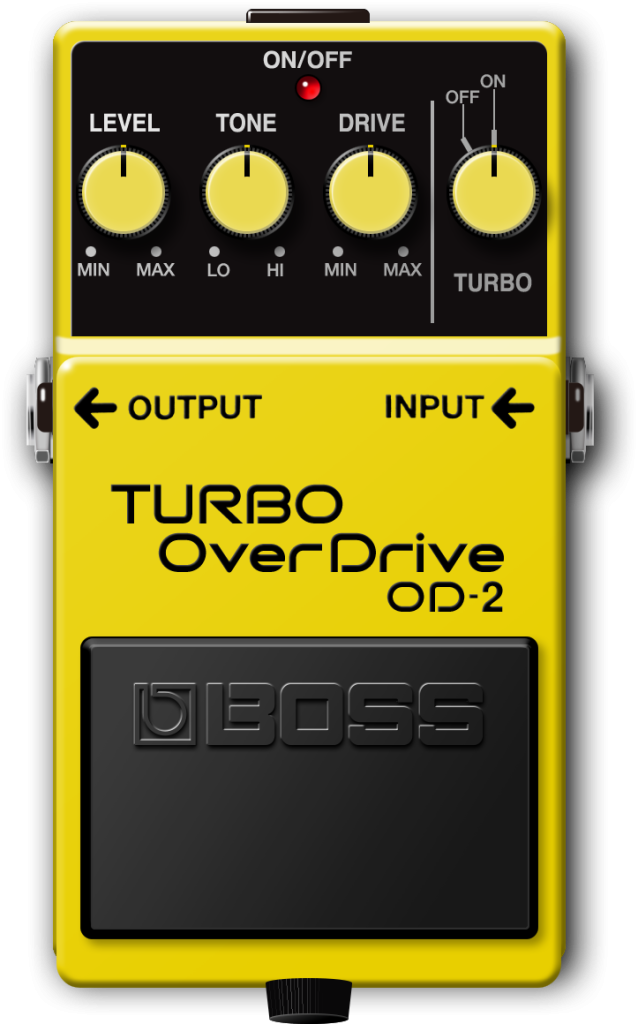
The OD-2 TURBO OverDrive was available from 1985 to 1995 and marked a major step forward from 1977’s original OD-1 Over Drive. While it retained the OD-1’s essential sound character, this dynamic dirt pedal featured a low-noise discrete signal path rather than an op-amp topology. In fact, it claims the distinction of being the first discrete-circuit pedal in the BOSS compact lineup.
Another key difference in circuitry included the inversion of the diode orientation, which produced a subtly altered response compared to the OD-1. Furthermore, the OD-2 boasted a dedicated Tone control—absent on the OD-1—allowing more precise shaping of high-frequency content.
With the Turbo switch disengaged, the OD-2 delivered a smooth, delicate overdrive closely related to the OD-1, albeit slightly milder in character. Engaging Turbo mode switched the circuit, introducing a dual-stage gain structure that did not rely on diodes for clipping. Instead, it drove the signal into distortion at the supply voltage in a manner comparable to tube amplifiers, producing a more aggressive, harmonically rich sound.
The OD-2 was embraced by a host of influential players, including Paul Gilbert, Johnny Marr, Jonny Greenwood, Prince, The Edge, and Jaco Pastorius. Thus, it has earned a lasting reputation as a versatile and expressive tool in both studio and live use.