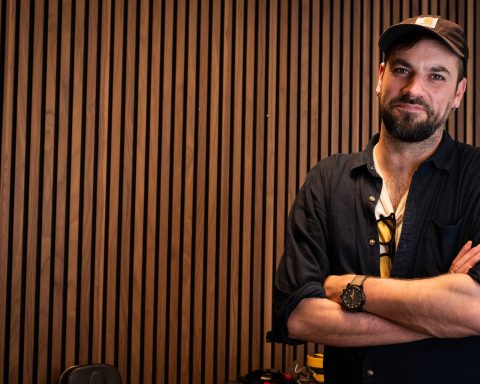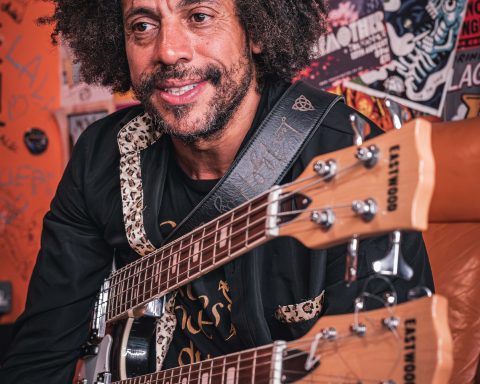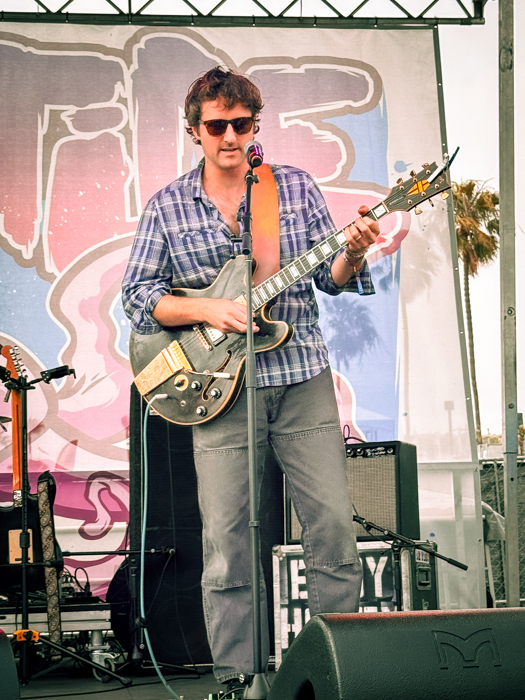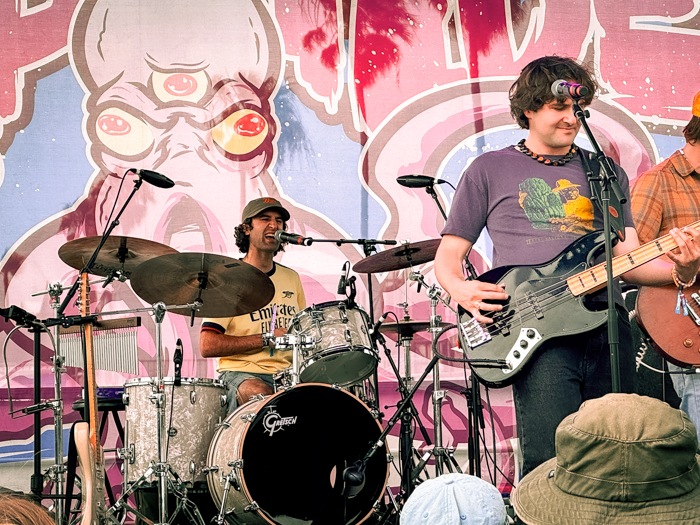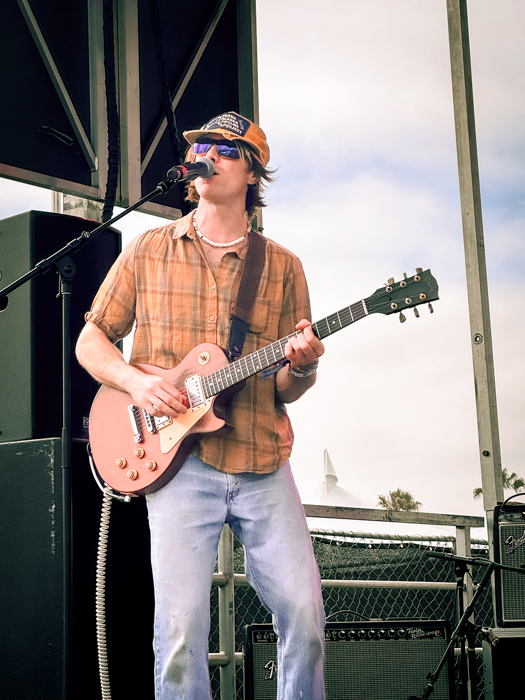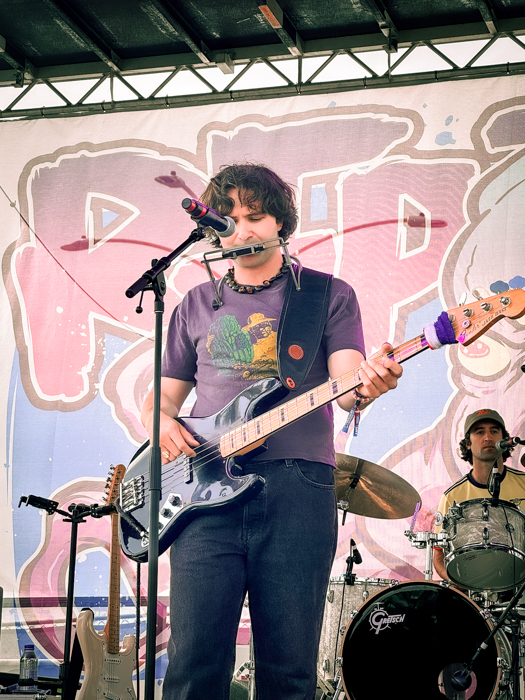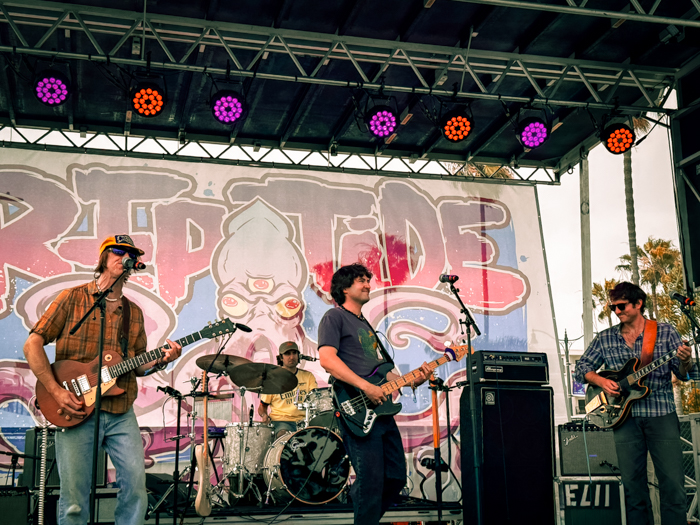
Hailing from Charleston, South Carolina, Easy Honey is Darby McGlone and Selby Austin on vocals and guitar, Webster Austin on bass and vocals, and Charlie Holt on drums and vocals. The indie‑rock four‑piece piled into a van and brought their sun‑soaked East Coast sound to the opposite shore at BeachLife Festival in Redondo Beach, California.
Sun, Sand, Sound
Relaxed and fully locked in, Easy Honey played like a band at home—despite much of the crowd discovering them for the first time. It didn’t take long to win people over. Mid‑set, when a game of hacky sack broke out in front of the stage, a barefoot Selby Austin waved the circle closer and motioned for the bag to be tossed up—without missing a beat. Easy Honey wasn’t just performing. They were having as much fun as their audience.
Just steps from the sands of the Pacific, the band members kicked back on a couch after their afternoon set to discuss their newly released EP, Plaid, the remote writing retreat that birthed the EP, and the BOSS pedals that achieve their “raucous” sound.
Signature Stomp
Festival shows reach a lot of new ears. How would you describe the Easy Honey sound to someone who’s never heard you before?
Selby Austin: Raucous yet sentimental.
Darby McGlone: Energetic and dynamic, ever-changing and cohesive, but also explorative.
What BOSS pedals do you use to achieve that sound?
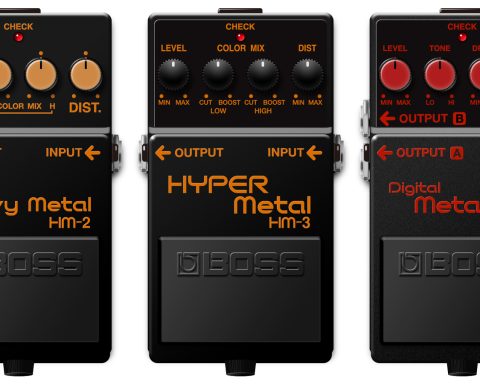
SA: You know what’s hilarious? I’ve had the BOSS pedals on my pedal board since high school. Since ninth grade, I’ve been ripping these same pedals.
DM: And then one of mine is Selby’s from high school. Webster’s pedalboard is 100% BOSS.
What are you using?
Webster Austin: The TU-3 Chromatic Tuner.
A tuner seems purely practical, but being in tune affects everything. How important is it to the foundation of your sound?
WA: There’s a point where tuning is important, and then there’s a scale that gets tipped when you’re making the show worse by obsessing about it. With a little bit of experience, you realize where you should fall.
SA: I love the BOSS Chorus. I have a Super Chorus that I’ve had since high school, and I always use it in some form or fashion.
"I like the tactile feel of stomping BOSS pedals. Stomp-ability is ten out of ten."
Selby Austin
Chorus tends to evoke feelings of nostalgia and a sense of movement. How does the Super Chorus factor into creating that dreamy sound in your songs?
SA: I like that Chorus because it can be subtle even when it’s cranked pretty high. It has a sweet sound. Honestly, we’ve used it on some bass recordings too. It’s a nice pedal. I like the tactile feel of stomping BOSS pedals. Stomp-ability is ten out of ten.
DM: I’m not that big of a tech guy, but the Blues Driver is badass. I like cranking the gain on it and getting a fuzzier tone.
WA: It’s his go to the moon, I’m about to rip pedal.
The Blues Driver is known for responding more to touch than heavy gain. How do you use it to shape dynamics live versus in the studio?
DM: I am sensitive with the volume knob when I click it on because I have the gain. In the studio, it’s so isolated that you’re more concerned about the tone. For me, if the feeling’s being conveyed, then I’m looser around the live show settings.
SA: The pedal cuts through, and there are times where it’s like he’s playing a lead solo and, boom, it comes on. It slaps.
Are there any other BOSS pedals on your wish list?
SA: I’d love a DS-2 Turbo Distortion.
Well-Worn Sound
You just released your new EP, Plaid. You posted on Instagram that “the songs on Plaid feel like fabric, warm but scratchy, crisscrossed yet cohesive.” How do you harness that lived-in feeling during writing or recording?
SA: We play together live a lot, and we’ve spent the last two or three years on the road, touring. That translates into the studio in some way, you know?
DM: This was a weird one. We didn’t really road-test the songs on Plaid, as we have in the past. We like doing that. They were incubated in this cabin when we recorded it and then taken to the road. So now, playing them live has informed the songs more.
How’s the response been?
WA: Pretty great!
SA: Yeah, positive—people jumping. It’s been really cool.
“Pink Lady” has kind of a Vampire Weekend vibe. Who are some of your influences?
SA: Dude, that was literally the reference! The production went in a slightly different, more rock-like way.
WA: Vampire Weekend. Pavement. We like Wilco, the Smashing Pumpkins, and Red Hot Chili Peppers. Neil Young. Elton John. Nick Drake. Widespread Panic!
Your sound balances warmth and movement in a really natural way. How early in your writing process do you think about tone?
SA: We’re a great team. Some of us are more tone-sensitive, some are more melody-driven. When EQing guitar or vocals, there’s an infinite range of how you can make a song. It’s never going to turn out the same exact way. That’s really what’s so cool about pedals. Those little differences add up by the time the song is finished.
Remote Writing Retreat
What’s your writing process?
SA: We start with a song that’s played on a guitar with vocals, that’s some of the way there. Then we hash it out as a band and work on it.
What was your writing retreat in the cabin like?
SA: It was really fun. So, so remote. We let our mountaineering buddy pick the place. We told him we like to record in cabins. And I’m talking about cabins like in Appalachia, where you pull up, and there’s a driveway, and a hot tub, and you just get out and roll your gear. So, we go with him; he picks the cabin, and we’re sledding our gear down a snowy mountain to reach it.
WA: It had power, though! It was an incredibly fun, cool experience.
How does your pedal usage vary between studio and stage?
SA: The studio is just the wild west. You can sit there and tinker. There’s a lot more care.
"I trusted the process of knowing that, as the set went on, people would love it."
Selby Austin
Coast to Coast
You guys are from Charleston. What’s the music scene like there?
DM: It’s a really cool scene. It’s very tight knit, interconnected, and supportive, which you don’t find in a lot of places.
SA: A lot of bands tour out of there, too, which is cool. It’s a small enough city where you can’t not tour.
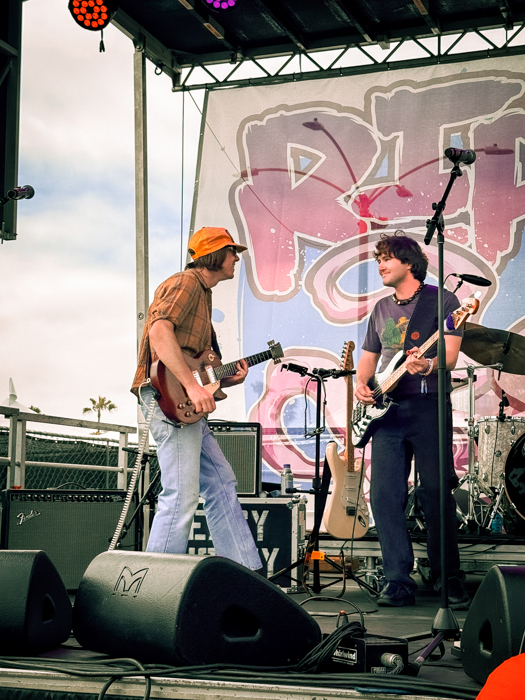
You can’t just stay in the city and play. But there are good rooms of all sizes. It’s a vibrant scene.
Charlie Holt: There’s not a lot of too cool for school there.
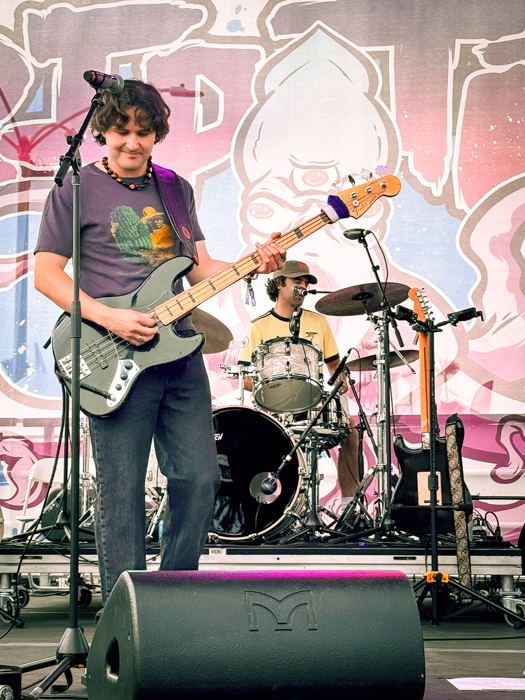
You have a very coastal sound. With the ocean as your backdrop here, are you feeling at home at BeachLife?
SA: We did feel at home. I trusted the process of knowing that, as the set went on, people would love it. Because we were playing to a little bit of a cold audience. We haven’t played much over here, so we’re still pretty undiscovered. I knew it was going to turn. And it did. About halfway through the set, people started getting excited and just vibing. It was fun.